Available 9am - 5pm EST


What Is a Pipe Coupling? Types, Materials, and Applications
What exactly is a pipe coupling? A pipe coupling is a fitting used to join two pipes, extend existing runs, or adapt pipes of different sizes or materials. This is important especially when we are talking about fixing a burst pipe, upgrading a commercial water line, or installing a new residential plumbing system.
In this article, we will cover everything you need to know about pipe couplings, from types and materials to installation, benefits, and its applications.
What Is a Pipe Coupling?
Let’s start with the definition: A pipe coupling is a fitting designed to connect two pipes or tubes, either in a straight line or as part of a more complex configuration. It is essentially that “bridging material” for pipes or tubes.
Couplings may join pipes of the same diameter or different diameters, and they can be temporary or permanent, rigid or flexible.
Pipe Couplings are essential for:
- Extending pipe runs
- Repairing broken or leaking pipes
- Adapting different pipe materials or pipe sizes
- Maintaining system continuity and integrity
They are mainly used in residential, commercial, and industrial plumbing as well as HVAC, mechanical, and marine systems. When it comes to installation of these couplings, there are official organizations guiding builders to ensure proper selection and installations.
They are guided by IAPMO, IPC/ICC, ASHRAE, AHRI, and NFPA standards to ensure safety and performance.
Materials of Pipe Couplings
Now that we got the definition out of the way, let us now dive deep into the different materials used to create pipe couplings. Choosing the materials would depend on application, pressure, temperature, and environmental conditions.
This is an overview of the usual materials for pipe coupling, their key features, and how they are usually used:
| Material | Key Features | Best Use Cases |
| Stainless steel 304 or 316 Stainless Steel | High corrosion resistance, durable, and high-temperature tolerance | Chemical plants, marine HVAC, food and beverage, firefighting systems, medical applications |
| Galvanized Steel | Cost-effective, corrosion-resistant for outdoor or wet environments | Outdoor plumbing, water supply lines, and general industrial use |
| Black Steel Pipe | Economical, durable, limited corrosion resistance | They get a black oxide coating when made. Low-pressure gas lines, structural applications with protective coating |
| Copper couplings | Excellent thermal conductivity, corrosion-resistant | Hot water supply, hydronic heating, HVAC systems |
| PVC / CPVC | Lightweight, chemical-resistant, easy to install | Drainage, potable water, chemical transport; CPVC for hot water |
| PEX | Flexible, quick installation, compatible with crimp or clamp fittings | Residential plumbing, radiant heating systems |
Tip: Always match the plumbing coupling material to the pipe material and operating conditions for durability and compliance.
How Pipe Couplings Work in Plumbing Applications
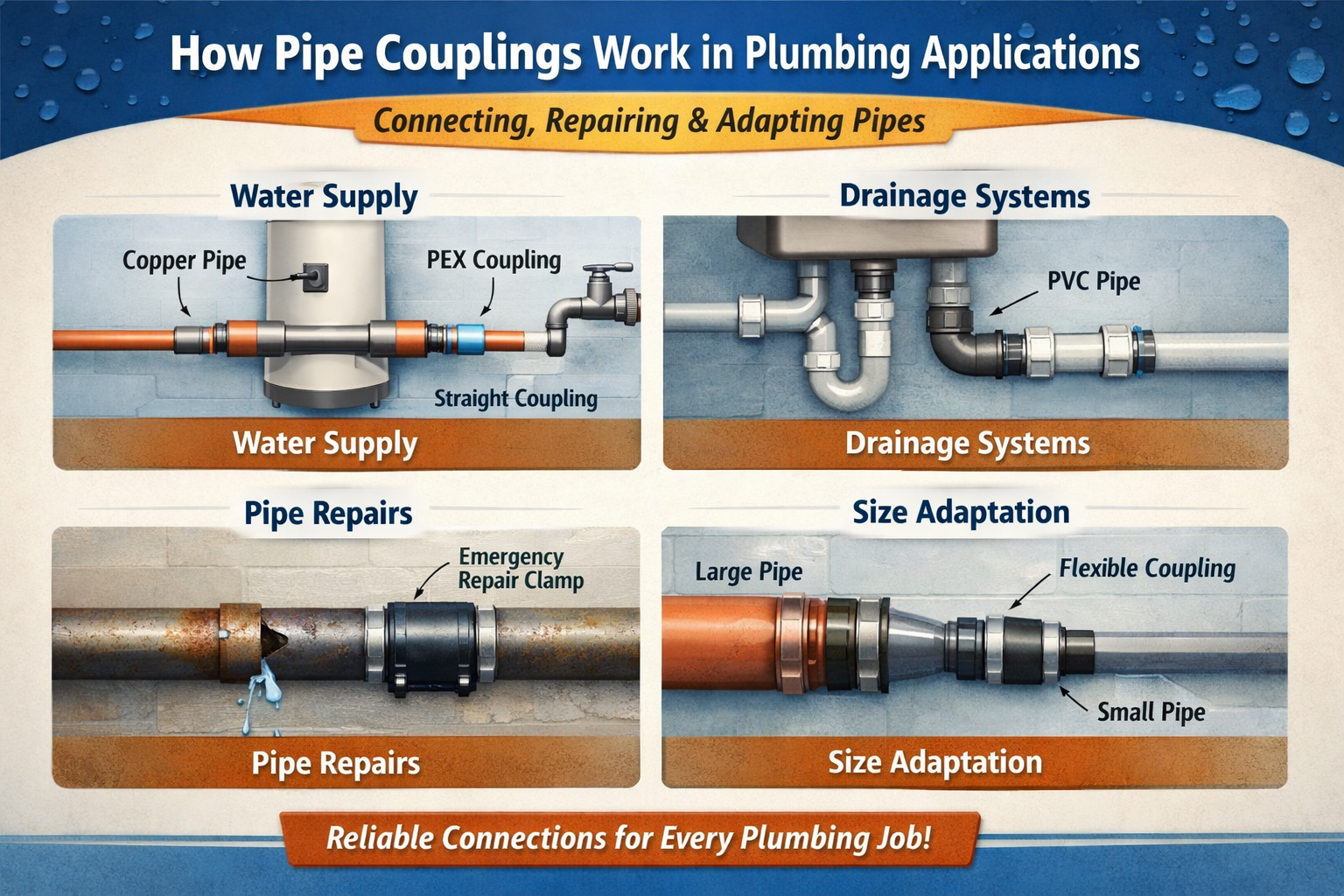
In plumbing, pipe couplings serve as essential connectors that maintain the continuity, safety, and efficiency of water supply and drainage systems. Their function is simple but highly critical: they join two sections of pipe, allow for repairs, and adapt pipes of different sizes or materials to work together.
Here are usual cases wherein Pipe couplings are used in plumbing:
Connecting Pipes
Pipe couplings create a secure link or in this case, as connecting pipes, between two pipes, regardless of the size or diameter. Let’s take a look at water supply lines for example. A full coupling can extend a water supply line by joining two copper pipes.
Another example is using a reducer coupling which allows a larger main line to connect to a smaller branch line feeding a fixture like a sink or toilet.
Repairing Leaks and Broken Pipes
They are also a life savior when it comes to plumbing. Couplings are also often used to repair damaged sections of plumbing without replacing entire runs of pipe.
Usually, a flexible coupling or slip-on coupling can be used to temporarily or permanently join pipes where a crack, hole, or corrosion has occurred. This is especially useful in tight spaces or older plumbing systems where replacement is difficult.
Transitioning Between Pipe Types
Prevention is always key when it comes to plumbing. Hence, reinforcements are usually used.
In modern plumbing systems, they frequently combine different materials, such as copper, PEX, PVC, or CPVC.
Couplings allow for smooth transitions between these materials, ensuring a watertight connection and avoid any damages. For instance, a plumber may use a threaded steel-to-PVC coupling to join an older galvanized line to a new PVC supply line.
Maintaining Water Flow and System Integrity
Properly installed couplings ensure that water flows efficiently and safely through the system. They prevent leaks, maintain pressure, and reduce the risk of water damage.
In drain, waste, and vent (DWV) systems, flexible or angled couplings can also help navigate obstacles and changes in direction while preserving system integrity.
Quick Installation in Emergency Situations
In emergency plumbing situations, couplings provide a fast solution to restore water service or prevent flooding. Push-to-connect PEX couplings, slip couplings, and flexible stainless steel couplings allow plumbers to make secure pipe connections quickly without specialized tools.
Types of Pipe Couplings
There are also types of pipe couplings to consider when doing any plumbing. Below, we listed down the usual types of pipe couplings you may come across.
Full Coupling
- Joins two pipes of the same diameter in a straight line
- Can be internally threaded couplings, soldered, or welded, depending on the material
- Common in water and wastewater systems, gas, and HVAC systems
Half Coupling
- Connects one pipe to another pipe coupling fitting or facility
- Ideal for branching from larger pipes or vessels
- Shorter than a full coupling and often through threaded connection
Reducer Coupling
- Connects pipes of different diameters
- Useful for transitioning from main supply lines to smaller feeder lines
- Common in residential and piping industry setups
Slip or Flexible Coupling
- Slip couplings slide over the pipe and have no internal stop
- Flexible couplings accommodate misalignment or vibration
- Often used in drain, waste, vent, and vibration-prone piping systems
Specialty Pipe-Fitting Shapes
- T or Cross Couplings: Connect more than two pipes
- Angled Couplings: Create bends without additional fittings
- Suitable for complex industrial or HVAC systems
Other Essential Pipe Fittings
In addition to couplings, plumbing and HVAC systems rely on a variety of other pipe fittings to ensure efficient flow, secure connections, and flexible layouts. Two of the most common are elbow fittings and T fittings.
Elbow Fittings
Elbows are used to change the direction of a pipe run, typically at 90 or 45 degrees. They are available in different materials such as steel, copper, PVC, CPVC, and PEX. Threaded elbows have internal or external threads for easy screwing onto metal pipes, while slip or push-fit elbows are common in PEX or PVC systems. Elbows are essential in plumbing layouts to navigate corners, avoid obstacles, or adjust pipe direction without bending the pipe itself.
Tee Fittings
Tee fittings, or T fittings, split coupler or combine flow in a pipeline. They allow a single line to branch off to supply water to sinks, toilets, or other fixtures. Tees are available in various materials and can have threaded or solvent-cemented connections depending on the system.
Installation Methods
As you read this article, you may already have an idea on what type or material you would need. Another factor you need to consider would be the installation. Proper installation is very critical for the performance and longevity of any piping system. There would be different materials that require different methods to ensure leak-free, secure connections.
Installation Methods for Pipe Couplings
Proper installation is crucial for the performance and longevity of any piping system. Different materials require specific methods to ensure secure, leak-free connections. Always follow code-approved installation methods from IPC, IAPMO, NFPA, or your local authority to guarantee safety and compliance.
Copper Couplings
When it comes to copper pipes, they are typically joined using soldering (sweat joints) or press fittings.
How soldering is done:
- The pipe and coupling are cleaned
- Flux is applied
- Heat is used to melt solder into the joint, creating a permanent seal.
- Press fittings are a modern alternative, using a hydraulic press to secure connections quickly without open flame.
- Both methods are ideal for potable water and hydronic heating systems, with press fittings especially useful in tight spaces or retrofit projects.
PEX Couplings
PEX couplings would also require systems that often use crimp rings, clamp fittings, or push-to-connect fittings. PEX couplings are flexible and versatile, making them perfect for residential plumbing, radiant heating, or DIY projects.
Crimp or clamp rings: secured with a tool that compresses the ring over the pipe and fitting
Push-to-connect fittings: allow pipes to be inserted directly for a fast, tool-free installation.
PVC Couplings and CPVC Couplings
PVC and CPVC pipes are joined using solvent cement or glue. This is often done with a primer applied first for CPVC.
The cement chemically fuses the pipe and fitting to create a permanent, water-proof connection. These couplings are widely used in drainage, potable water, and chemical applications due to their durability and ease of installation.
Steel Couplings
Steel pipe couplings would also have a different installation method. They can be connected using threaded fittings or compression rings. Threaded ends use PTFE or teflon tape or pipe dope on male threads and are tightened with wrenches, providing strong joints for high-pressure water, gas, or industrial piping. Compression fittings compress a ferrule over the pipe to form a reliable seal.
Steel couplings are often used in gas and industrial applications where precision and durability are absolutely critical.
Flexible Couplings
Flexible couplings, secured with stainless steel clamps, are ideal for repair applications, misaligned pipes, or systems subject to vibration. These couplings are commonly used in drain, waste, and vent (DWV) systems and can provide a quick, leak-resistant solution in emergency repairs.
Benefits of Pipe Couplings
| Benefit | Explanation / Example |
| Leak Prevention | Tight seals reduce the risk of pipe failures in high-pressure or corrosive systems |
| Cost-Effective Repairs | Minimize welding or replacement; fast installation saves labor costs |
| Material Flexibility | Available in stainless steel, PVC, PEX, brass, and more |
| System Adaptability | Can join pipes of different sizes or materials for complex installations |
| Emergency Repairs | Quick replacement or temporary fix in commercial or residential emergencies |
| Code-Compliant Installation | Using proper couplings ensures safety and compliance |
Pro Tip: Follow code-approved installation methods such as IPC, IAPMO, or NFPA to ensure leak-free and safe connections.
Applications of Pipe Couplings
- Residential Plumbing: Water supply, hot and cold lines, drainage systems
- Commercial Plumbing: High-rise building piping, industrial kitchens, and laboratories
- HVAC Systems: Air supply, hydronic heating, chilled water systems
- Industrial and Manufacturing: Firefighting, chemical plants, compressed air systems
- Offshore Marine Applications: Freshwater and seawater piping, HVAC on ships
- Automotive and Engineering: Exhaust systems, muffler connections
Tip: Always choose couplings and fittings that meet applicable codes to ensure safe, reliable, and inspection-ready installations.
FAQs About Pipe Couplings
- Q1: What is the difference between full and half couplings?
A: Full couplings join two pipes of the same diameter. Half couplings are used for branching off a main line or connecting to a vessel. - Q2: Can couplings be used in high-pressure systems?
A: Yes, but ensure they are rated for the system’s pressure and have proper sealing or threading. - Q3: How do I choose the right material?
A: Consider fluid type, temperature, pressure, and environment. Stainless steel is ideal for corrosive or high-temperature environments. Galvanized steel works for outdoor use. - Q4: Are pipe couplings reusable?
A: Some types, such as slip or compression couplings, can be reused. Welded or solvent-cemented couplings are permanent. - Q5: Where can I get emergency plumbing supplies or high-quality couplings?
A: Reliable suppliers such as 24hr.supply offer 24/7 access to professional-grade fittings.
Get Your Plumbing Projects Done Right with 24hr Supply
Pipe couplings are essential for connecting, repairing, and adapting plumbing and HVAC pipes. Choosing the right type of fittings and material ensures a secure, leak-free system. Proper installation and code compliance keep your plumbing safe and reliable.
At 24hr Supply, we make it easy to get the professional plumbing and heating supplies you need. Shop online today for couplings, fittings, and all your plumbing parts and take advantage of fast 24-hour delivery and expert support. Get the right parts when you need them and keep your projects moving without delay.
Recent Posts
-

Approximate Cost to Install New Plumbing
The approximate cost to install new plumbing in the United States ranges from $7,000 to $15,000 for …Mar 9th 2026 -
Quick Fixes for a Gurgling Kitchen Sink
A gurgling kitchen sink can be quite a nuisance since it makes such an annoying noise. It usually si …Feb 26th 2026 -
ABS Pipe vs PVC: Choosing the Right Plumbing Solution
ABS pipe vs PVC pipe are two of the most common plastic piping options in plumbing today. ABS (Acryl …Feb 24th 2026