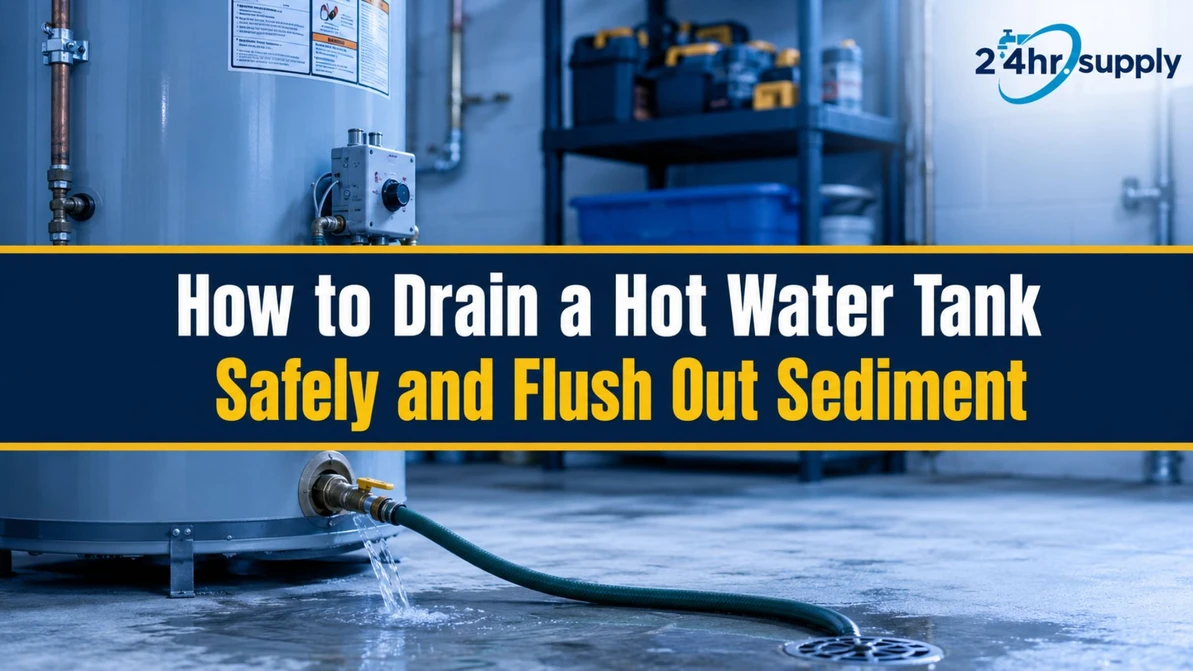
How to Drain a Hot Water Tank and Fix Slow, Blocked, or Leaking Drainage Safely
A water heater often gives a few clues before it needs attention. You may hear rumbling from the tank, notice less hot water than usual, or see cloudy water during maintenance. Sometimes the tank simply needs to be emptied before a repair or replacement.
Learning how to drain a hot water tank helps you handle those situations with fewer surprises. The job is fairly direct, though the tank may hold dozens of gallons of scalding water. But the order of the steps matters.
In this article, you will learn how to prepare, drain, flush, refill, troubleshoot, and decide whether replacement parts are needed.
What Do You Need Before Draining the Tank?
You need a safe discharge route, a suitable hose, basic hand tools, and protective equipment before draining the tank.
Preparation can feel like the boring part. We still take it seriously because a small setup mistake can leave hot water across a basement or utility-room floor. A DOE fact sheet says storage water heaters usually hold 20 to 80 gallons , so even a smaller tank can release a considerable volume.
Here are the basic items you should gather:
- A garden hose suitable for the expected water temperature
- A bucket or drain pan
- A flat-head screwdriver or drain-valve key
- Work gloves
- Eye protection
- Towels or absorbent rags
- An optional non-contact voltage tester
- An optional transfer pump when gravity drainage is impossible
The hose should reach a floor drain, safe outdoor area, or another suitable discharge point. It should also slope downward when the system relies on gravity.
Another thing, take a close look at the drain valve before starting. Old plastic valves can crack, and corroded valves may refuse to close once opened. If the valve already looks damaged or damp, we recommend planning for repair before touching it.
Pro tip: Review these water heater safety guidelines before working around hot water, electricity, gas controls, or pressure-related components.
How to Drain a Hot Water Tank Step by Step
The safest way to drain a hot water tank is to shut down the energy source, cool the water, connect a hose, admit air, empty the tank, flush it, and refill it in that order.
The work is simple when each step goes as expected. Problems usually begin when someone rushes the shutdown or restores power too early.
Here are the steps we follow.
1. Check the Manual and Identify the Heater Type
Find the model number and review the manufacturer’s instructions before opening any valve. Confirm whether the unit runs on gas or electricity.
The physical drainage steps are similar for both types. Shutdown, restart, and pilot-light procedures can vary from one model to another.
2. Turn Off the Energy Source
For an electric heater , switch off the correct breaker at the electrical panel. Use a non-contact voltage tester when the setup allows safe access, and you know how to use it.
And for a gas model, follow the manufacturer’s shutdown or pilot-setting instructions. Never guess at gas controls or relighting steps.
3. Let the Water Cool
Give the water enough time to cool before opening the tank. Treat every drop as dangerously hot until you have confirmed a safer temperature.
The CPSC says most adults can suffer third-degree burns from 150°F water in two seconds , 140°F water in six seconds , 130°F water in 30 seconds , and 120°F water in five minutes . Gloves help, though distance and cooling time matter more.
4. Shut Off the Cold-Water Supply and Connect the Hose
Close the cold-water inlet valve above or near the tank. Then attach the garden hose firmly to the drain valve near the bottom.
Route the other end to a floor drain or suitable outdoor discharge area. Make sure the destination can handle the volume without flooding, damaging plants, or sending water back toward the foundation.
5. Open a Hot-Water Faucet and the Drain Valve
Open a hot-water faucet somewhere in the home. This lets air enter the plumbing system and helps prevent a vacuum inside the tank.
Then open the drain valve slowly. The faucet allows air movement, though it will not empty the tank once the cold-water supply has been closed. And the water leaves through the drain valve and attached hose.
6. Let the Tank Empty
Watch the hose, valve, drain point, and nearby floor while water flows. A small leak can spread quickly when nobody is paying attention.
Drainage time varies. So, tank size, hose length, hose diameter, elevation, sediment buildup, and valve condition all affect the flow.
But a clean tank with a short downhill hose may empty much faster than an older tank with a restricted valve.
7. Flush the Tank Until the Water Runs Clear
After the initial water drains, briefly reopen the cold-water supply while the drain valve stays open. Check the heater manual first because model instructions can differ.
Fresh water stirs up loose sediment at the bottom of the tank and pushes it through the hose. So, close the supply again and allow the tank to drain. Repeat the process until the discharge looks reasonably clear.
8. Close, Refill, Check, and Restart
Close the drain valve fully and remove the hose. Reopen the cold-water supply and keep a hot-water faucet open while the tank refills.
At first, the faucet may spit air and water. A steady stream usually shows that the tank is filling and that trapped air is clearing from the lines. Check the drain valve, nearby fittings, and floor for leaks.
Restore electricity or gas only after the tank is completely full. Powering an empty electric heater can burn out the heating elements in a short time.
If you’re more of a visual learner, check out this YouTube video to see 2 ways of draining a hot water tank:
What Is the Difference Between Draining and Flushing a Hot Water Tank?
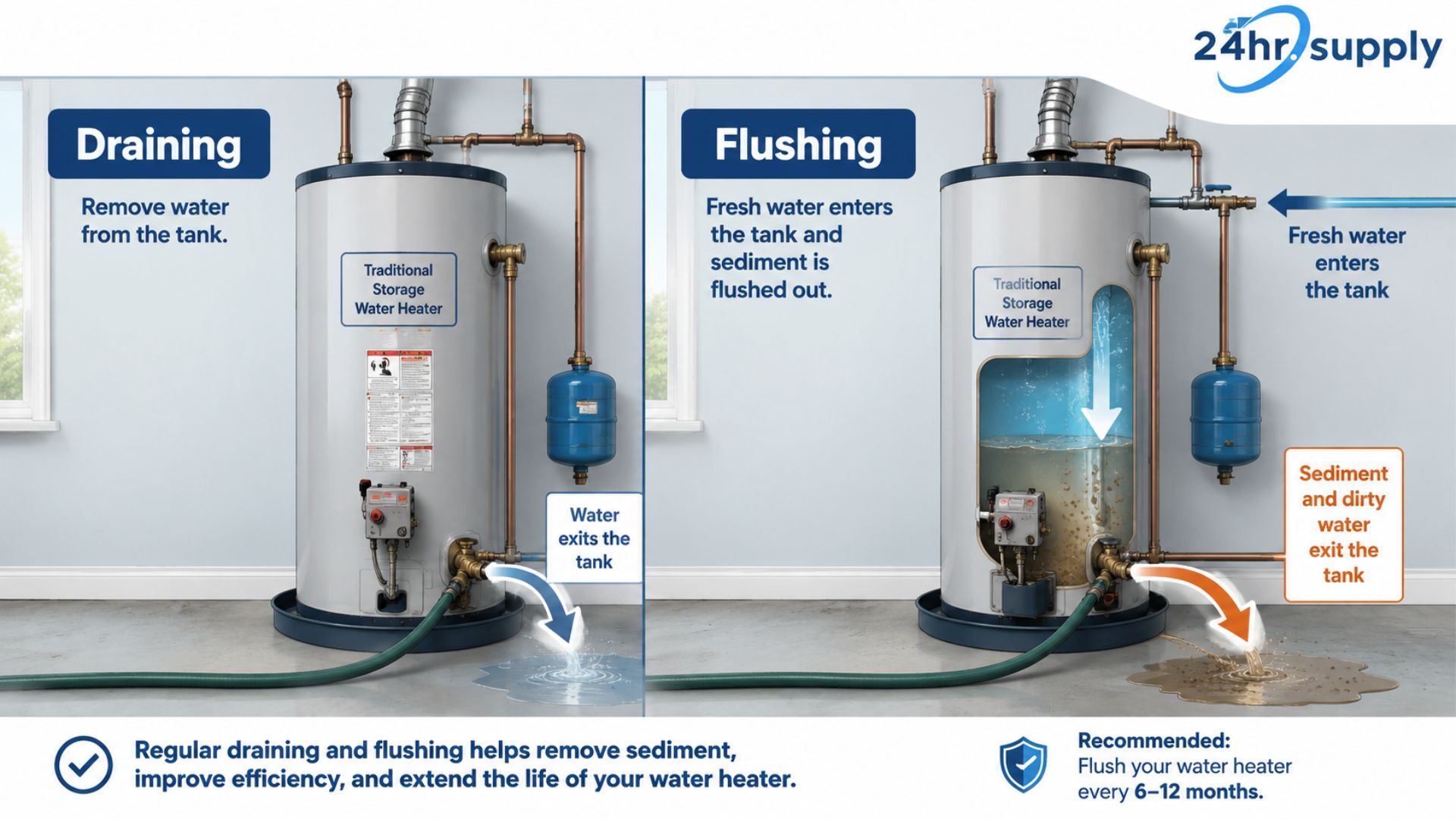
Draining removes the stored water from the tank, while flushing uses fresh water to carry loose sediment through the drain valve.
A tank may need to be drained before repair, replacement, relocation, or seasonal shutdown. In those cases, the goal is usually to remove as much stored water as possible.
Flushing serves a different purpose. It clears minerals, grit, rust particles, and other debris that settle near the bottom over time. Most routine maintenance involves both actions. The tank empties first, and then fresh water moves through it.
Tankless water heaters use a separate descaling process with isolation valves, hoses, and a circulating pump. So, follow a dedicated tankless guide for those systems.
Should You Drain a Hot Water Tank?
Yes, most storage-tank water heaters benefit from periodic draining and flushing when the manufacturer recommends it, and the unit is in suitable condition.
Homeowners and contractors often ask, “Should you drain a hot water tank?” on a fixed yearly schedule. There is no single interval that fits every unit. Water hardness, water source, tank age, household demand, and maintenance history all affect how quickly sediment develops.
The DOE considers annual draining and flushing of storage heaters a maintenance cost because the work can minimize sediment, maintain operating efficiency, and prolong product life.
PNNL also reports that hard water can create sediment at the bottom of the tank, reduce efficiency, shorten equipment life, and increase maintenance needs.
These are the common signs that maintenance may be useful:
- Popping or rumbling sounds from the tank
- Reduced usable hot-water capacity
- Cloudy, gritty, or discolored discharge
- Slower heating or declining performance
- Planned repair, replacement, or relocation
- A maintenance interval listed in the owner’s manual
Pro tip: If the tank has other symptoms, our guide to common water heater problems can help you narrow down the cause before you start replacing parts.
We recommend starting with the heater manual. A well-maintained tank in an area with softer water may need a different schedule from an older tank supplied by very hard or sediment-heavy water.
Age also matters. A neglected tank with a brittle drain valve may develop a leak once the valve is disturbed. In that situation, an inspection may make more sense before a full flush.
Why Is the Hot Water Tank Draining Slowly?
A tank usually drains slowly because the hose is restricted, air cannot enter properly, or sediment has partially blocked the drain valve.
Slow hot water tank draining is common on older units. Sometimes the cause is simple, such as a kinked hose. Other times, mineral buildup has packed around the valve opening.
According to the same research from PNNL, lime scale can clog both the drain valve and the temperature-and-pressure relief valve. That can make drainage harder and may affect the performance of a safety-related component.
Here are the most common problems and next steps:
| Problem | Likely cause | Practical next step |
|---|---|---|
| No water comes out | Closed valve, air lock, blocked valve, or incorrect setup | Recheck the faucet, hose, supply valve, and drain valve positions |
| Flow is only a trickle | Sediment, kinked hose, long hose, or uphill routing | Straighten and lower the hose; avoid forcing the valve |
| Valve leaks after draining | Worn seal, damaged plastic, or corrosion | Shut off the supply and arrange valve replacement |
| Water remains brown | Sediment, rust, or tank deterioration | Continue flushing briefly and seek inspection if discoloration persists |
| Faucet sputters after refill | Air remains in the line | Leave the faucet open until the flow becomes steady |
Avoid jabbing wire or tools into an old valve unless the manufacturer specifically approves that method. A blocked valve can become a broken valve very quickly.
Pro tip: Before opening anything, review our guide to water heater valves so you can identify the drain, shutoff, and pressure-relief components correctly.
When Should You Stop and Call a Plumber?
Stop and call a plumber when the tank, drain valve, gas controls, or electrical supply creates a risk you cannot manage confidently.
DIY maintenance has a clear limit. We would rather stop early than turn a slow valve into a flooded room or a gas-control problem. These are the main warning signs:
- The drain valve will not open, close, or reseal
- The tank body is leaking
- Severe corrosion is visible
- The heater is very old and has never been flushed
- You are unsure about a gas or electrical shutdown
- There is no safe drainage route
- Heavy sediment repeatedly blocks the valve
- Water remains rusty after flushing
Draining may expose an existing weakness. It cannot repair a leaking tank body or reverse serious corrosion.
Find Water-Heater Parts and Replacement Products at 24hr Supply
When maintenance reveals a damaged valve, failed connection, or worn-out tank, 24hr Supply can help you find the parts needed for the next stage.
24hr Supply carries residential and commercial water heaters, boiler drains, quarter-turn drain valves, water-heater pans, braided connectors, relief valves, pumps, fittings, plumbing tools, and related installation components. Our deep-stocked inventory and fast fulfillment on many in-stock items can help contractors and property owners avoid long delays.
Possible drain-valve options include the Everflow 4634 3/4-inch MIP x hose boiler drain and the Raven 34BDCL quarter-turn boiler drain .
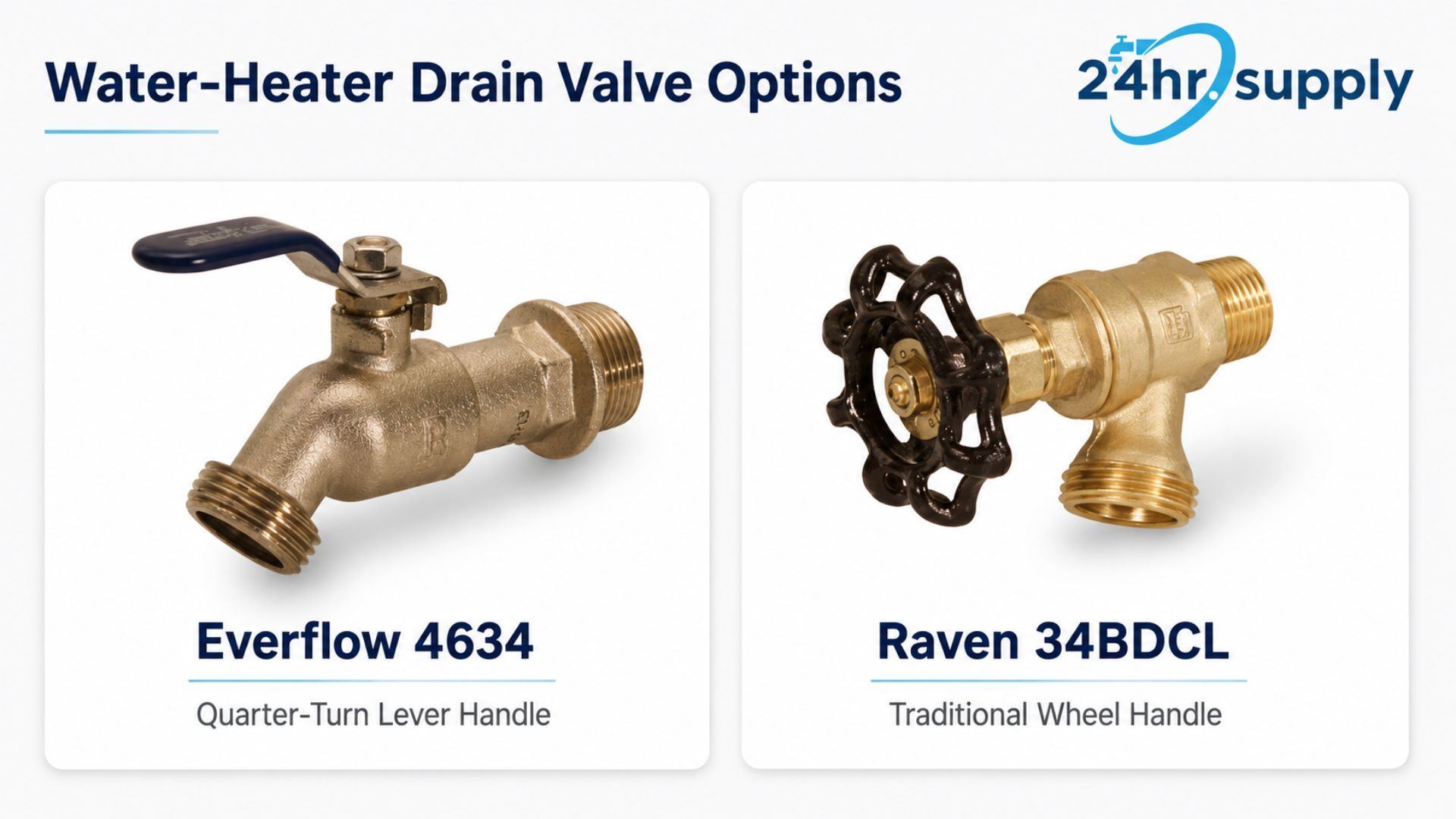
But compatibility still matters. So, check the thread size, connection style, material, temperature rating, heater specifications, and local requirements before purchase or installation.
24hr Supply also provides product specification sheets and customer support for product selection. You can review the live product details or contact the team for help identifying a compatible part.
FAQs
How long does draining take?
Drain time depends on tank size, hose length, hose position, sediment buildup, and valve condition. A clear downhill setup can move quickly, while a restricted valve may take much longer.
Can you empty the tank through a faucet?
The faucet mainly lets air enter the plumbing system. And the water leaves through the drain valve near the bottom of the tank.
Should you open the T&P relief valve?
Follow the manufacturer’s manual before operating the temperature-and-pressure relief valve. Older valves can stick or fail to reseal after they are opened.
Can you drain a tankless water heater this way?
Tankless units use a different maintenance process. They usually require isolation valves, hoses, a pump, and a manufacturer-approved descaling solution or procedure.
How do you know the tank is full again?
Keep a hot-water faucet open during refilling. A steady flow without repeated bursts of air is the main practical sign that the tank has filled and the lines have cleared.
Recent Posts
-

How to Prime a Grundfos Pump: Step-by-Step Instructions for Homeowners
If your pump is running but the tap is still dry, switch it off before checking whether it needs pr …Oct 12th 2026 -
How Does a Grundfos Pump Work? Types, Controls, and Everyday Uses
Grundfos centrifugal pumps work through an electric motor that turns an impeller, transfers energy t …Oct 12th 2026 -
Gruvlok vs. Victaulic: Key Differences in Couplings, Fittings, and Performance
A contractor, estimator, engineer, or buyer may find one grooved piping brand listed in the project …Sep 15th 2026