How to Choose the Right Booster Pump for Your Building
For plumbers and DIY property owners, the most common mistake is choosing a pump based solely on horsepower. The right selection depends on four key factors: building height, required water pressure (PSI), water demand (GPM), and whether you need constant pressure.
Let’s dive into this article and break down how to choose the right booster pump.
What Does a Booster Pump Do?
A booster pump increases water pressure inside a plumbing system. It is so incredibly important as a plumber or even a DIY-er to keep in mind these four things when choosing the right booster pump for your project.
You can mostly find it in places such as:
- Upper floors
- Long pipe runs
- Commercial fixtures
- High-demand plumbing systems
Booster pumps are common in:
- Apartment buildings
- Hotels
- Restaurants
- Schools
- Large homes
- Commercial properties
You can definitely see how important booster pumps are. Without enough pressure, fixtures may run weakly or stop working properly during peak demand.
How to Choose The Right Booster Pump?
The right booster pump is not chosen based on the cheapest one, or even the brand.
In this picture, we are showing the Grundfos CMBE 1-44 Booster Pump to help you understand how booster pumps work in real applications. This model demonstrates how a modern pump maintains constant pressure while adjusting its speed based on water demand.
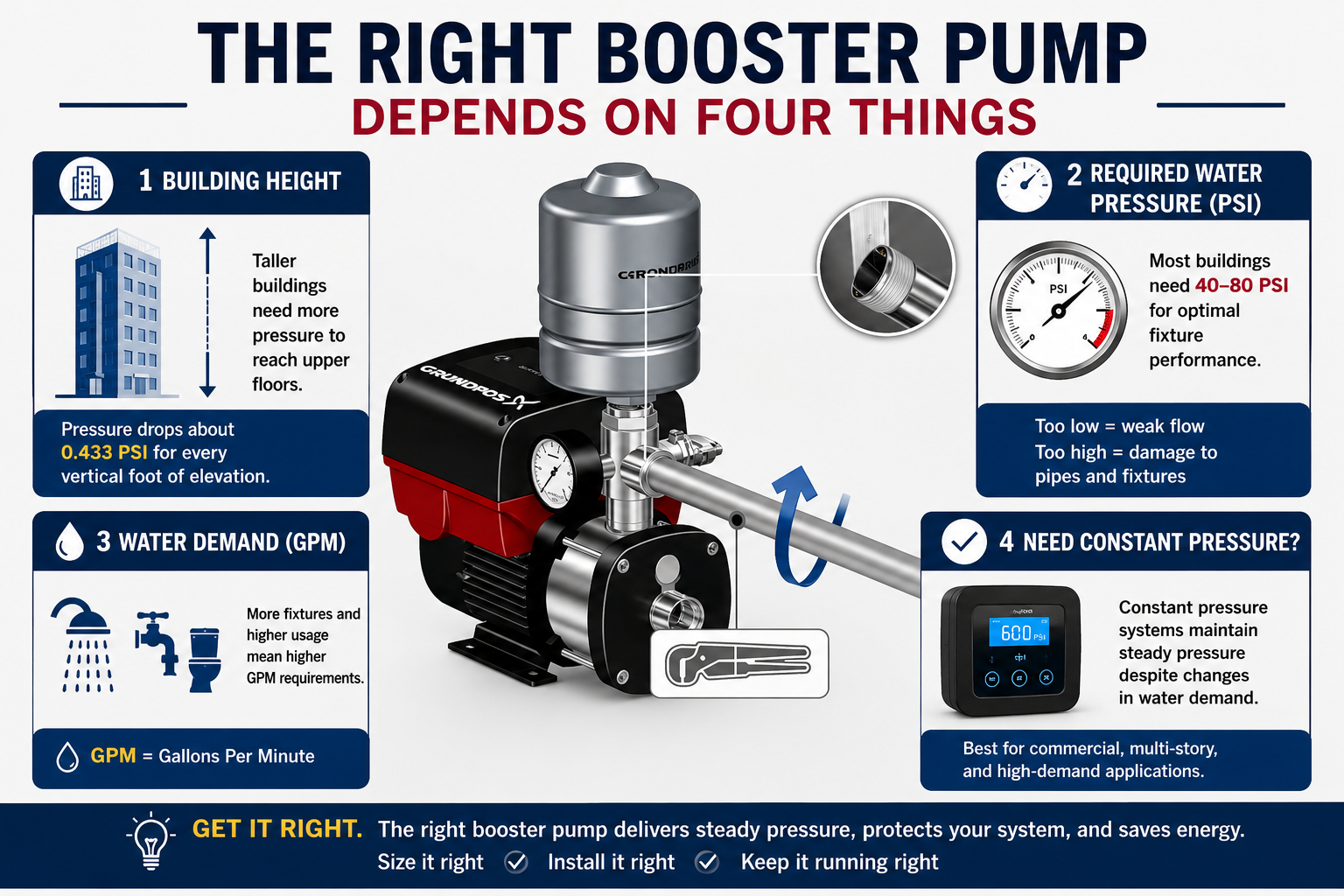
We know that it may seem really complicated and confusing at first. So, we put together a simple but important checklist of four key factors that determine how well your system will perform:
- Building height
- Required water pressure (PSI)
- Water demand (GPM)
- Whether you need constant pressure or not
Going through this checklist helps ensure you choose a booster pump that can handle your building’s actual water needs without pressure drops or performance issues.
The Importance of Booster Pumps
Let’s take a closer look at one of the most common problems that happens when a booster pump is not properly selected or sized for the system. Many water pressure issues in buildings actually start here.
Why Do Buildings Lose Water Pressure?
Buildings lose pressure because gravity and pipe friction reduce the water force as water travels upward. The pressure drops about 0.433 {PSI per vertical foot}.
We got a bit technical there but to put it simply, let’s say a 100-foot-tall building loses roughly 43 PSI before water even reaches the top floor.
There are other causes as well such as:
- Undersized piping
- Dirty filters
- Partially closed valves
- High fixture demand
- Old galvanized pipe buildup
This is why many commercial systems still require booster pumps even when city pressure seems adequate at ground level.
The Different Sizes and Types of Booster Pumps
What Size Booster Pump Does a Building Need?
Booster pump sizing depends on:
- PSI requirements
- Gallons per minute (GPM)
- Building height
- Pipe size
- Fixture count
Here is a basic sizing reference.
| Building Type | Common Pump Type | Typical PSI Range |
|---|---|---|
| 2-story home | Single-stage | 40 to 60 PSI |
| 4 to 6-story apartment | Multi-stage | 60 to 90 PSI |
| Hotel | VFD constant-pressure system | 80 to 140 PSI |
| Commercial building | Duplex booster system | 100 to 160 PSI |
For most residential fixtures:
- 40 to 60 PSI works well
- Below 40 PSI feels weak
- Above 80 PSI may damage fixtures
You also wouldn’t want too much water pressure. According to the IAPMO guidance, excessive pressure can shorten the lifespan of valves, faucets, and appliances.
What Happens if a Booster Pump Is Too Small?
An undersized booster pump causes:
- Weak showers
- Slow fixture flow
- Pressure drops during peak hours
- Inconsistent hot water delivery
This becomes obvious in:
- Apartment buildings
- Hotels
- Multi-bathroom homes
For DIY installers, this is something you need to watch closely. Many people underestimate simultaneous water demand, which can quickly overload a small system.
For example, if two showers are running at the same time while a dishwasher and washing machine are also in use, the combined demand can easily overwhelm a small residential booster pump.
What Is the Difference Between Single-Stage and Multi-Stage Booster Pumps?
Single-Stage Booster Pumps
Single-stage pumps use one impeller.
They work best for:
- Small homes
- Light residential use
- Simple plumbing systems
Pros:
- Lower cost
- Easier installation
- Simpler maintenance
Cons:
- Lower pressure capacity
- Not ideal for tall buildings
Multi-Stage Booster Pumps
Multi-stage pumps use multiple impellers to generate higher pressure.
They are commonly used in:
- Commercial buildings
- Hotels
- Multi-family housing
- Industrial facilities
Pros:
- Higher pressure output
- Better efficiency
- More stable water delivery
Cons:
- Higher upfront cost
- More complex controls
For commercial plumbing supplies projects, multi-stage systems are usually the better long-term choice.
Important Questions to Ask When Buying a Booster Pump
Should You Use a Variable-Speed Booster Pump?
In most cases, yes.
Variable-speed booster pumps use a VFD, or variable frequency drive, to adjust motor speed based on water demand.
Instead of running at full power constantly, the system ramps up or down automatically.
Benefits include:
- Lower energy bills
- Quieter operation
- Stable water pressure
- Less water hammer
- Longer pump life
If you are a contractor working for bigger plumbing projects, it is also important to note that ASHRAE Standard 90.1 reinforces the use of variable-speed pumping systems as a primary strategy for reducing energy waste in commercial HVAC systems.
Fixed-speed pumps still works well especially for smaller projects such as:
- Small homes
- Basic irrigation systems
- Low-demand applications
How Much Water Flow Does a Booster Pump Need?
Flow rate matters just as much as pressure. A common sizing mistake is installing a pump with enough PSI but not enough flow capacity.
For example, a building may require around 80 PSI of pressure and up to 120 GPM during peak demand.
If the pump cannot deliver both the required pressure and flow at the same time, the system will struggle to keep up, and noticeable pressure drops will still occur throughout the building.
Typical high-demand fixtures include:
- Commercial showers
- Flush valves
- Tankless water heaters
- Commercial dishwashers
Can a Booster Pump Damage Pipes?
Yes, if the system is oversized or improperly installed.
High pressure can cause:
- Water hammer
- Leaking fittings
- Burst washing machine hoses
- Fixture damage
- Valve failure
That is why we also recommend that most plumbing systems should stay below 80 PSI.
Pressure-reducing valves and expansion tanks may also be required depending on the system layout.
This is especially important in older homes with aging piping.
Example: Booster Pump for a 5-Story Apartment Building
Here is a simplified real-world example.
Building details:
- 5 stories
- 20 apartments
- Approximate height: 55 feet
- Peak demand: 75 to 90 GPM
Likely system recommendation:
- Multi-stage booster pump
- Variable-speed control
- Operating pressure around 85 to 110 PSI
Additional components may include:
- Check valves
- Pressure tank
- Isolation valves
- Pressure sensors
This type of setup is common in modern commercial plumbing supplies installations.
What Maintenance Does a Booster Pump Need?
Booster pumps need periodic inspection to stay reliable.
Basic maintenance includes:
- Checking seals
- Inspecting bearings
- Monitoring pressure settings
- Cleaning filters
- Testing pressure tanks
Warning signs of trouble:
- Loud vibration
- Rapid cycling
- Pressure fluctuations
- Motor overheating
- Visible leaks
Having access to emergency plumbing supplies is important because downtime can affect an entire building.
Where Should You Buy a Booster Pump?
For plumbers and serious DIYers, product quality matters more than buying the cheapest unit online.
A reliable HVAC supply distributor or plumbing supply store online should offer:
- Commercial-grade pumps
- Technical support
- Replacement parts
- Pressure tanks
- Valves and fittings
- Emergency inventory access
This becomes critical when working on:
- Commercial repairs
- Apartment buildings
- After-hours emergencies
- System retrofits
Here at 24hr Supply, we help contractors and property owners source commercial plumbing supplies and emergency replacement components quickly.
Ready for an Upgrade?
Choosing the right booster pump is not just about increasing pressure. The real goal is stable water flow, efficient energy use, and long-term system reliability.
For plumbers, contractors, and DIY property owners, the best approach is to size the system based on:
- Building height
- Fixture demand
- Pipe layout
- Peak water usage
When a booster pump is properly matched to these conditions, it helps eliminate pressure complaints, reduces stress on plumbing fixtures, and improves overall system performance.
If your system is due for an upgrade or you need reliable parts for a project, you can explore commercial plumbing supplies, pumps, valves, fittings, and HVAC components at 24hr Supply.
Recent Posts
-

How to Prime a Grundfos Pump: Step-by-Step Instructions for Homeowners
If your pump is running but the tap is still dry, switch it off before checking whether it needs pr …Oct 12th 2026 -
How Does a Grundfos Pump Work? Types, Controls, and Everyday Uses
Grundfos centrifugal pumps work through an electric motor that turns an impeller, transfers energy t …Oct 12th 2026 -
Gruvlok vs. Victaulic: Key Differences in Couplings, Fittings, and Performance
A contractor, estimator, engineer, or buyer may find one grooved piping brand listed in the project …Sep 15th 2026