Why Is the Water Pressure Low in My Bathroom Sink?
Low bathroom sink water pressure is usually caused by a clogged aerator, mineral buildup, partially closed shut-off valves, or a blocked faucet cartridge. In most homes, the issue affects only the sink itself and can often be fixed in under 30 minutes without replacing the entire faucet.
Most Common Bathroom Sink Pressure Problems
There are several reasons why bathroom sink water pressure can suddenly drop. To help you identify the issue faster, we’ve gathered the most common causes along with simple, practical fixes you can try before calling a professional.
| Bathroom Sink Problem | Most Likely Cause | Typical Fix |
|---|---|---|
| Weak hot and cold water | Clogged aerator | Clean or replace aerator |
| Low hot water pressure only | Water heater sediment | Flush heater or replace cartridge |
| Pressure dropped suddenly | Sediment blockage | Clean faucet and supply lines |
| One sink affected | Faucet cartridge issue | Replace cartridge |
| Whole house pressure low | Pressure regulator failure | Inspect PRV |
| Sink sputters or sprays unevenly | Mineral buildup | Clean aerator |
Take note that this is only a summary. Read on to find out more and how you can address this issue quickly.
Why Is the Water Pressure Low Only in My Bathroom Sink?
If you have noticed that the low water pressure affects only one bathroom sink, the problem is usually local to that fixture.
The most common causes include:
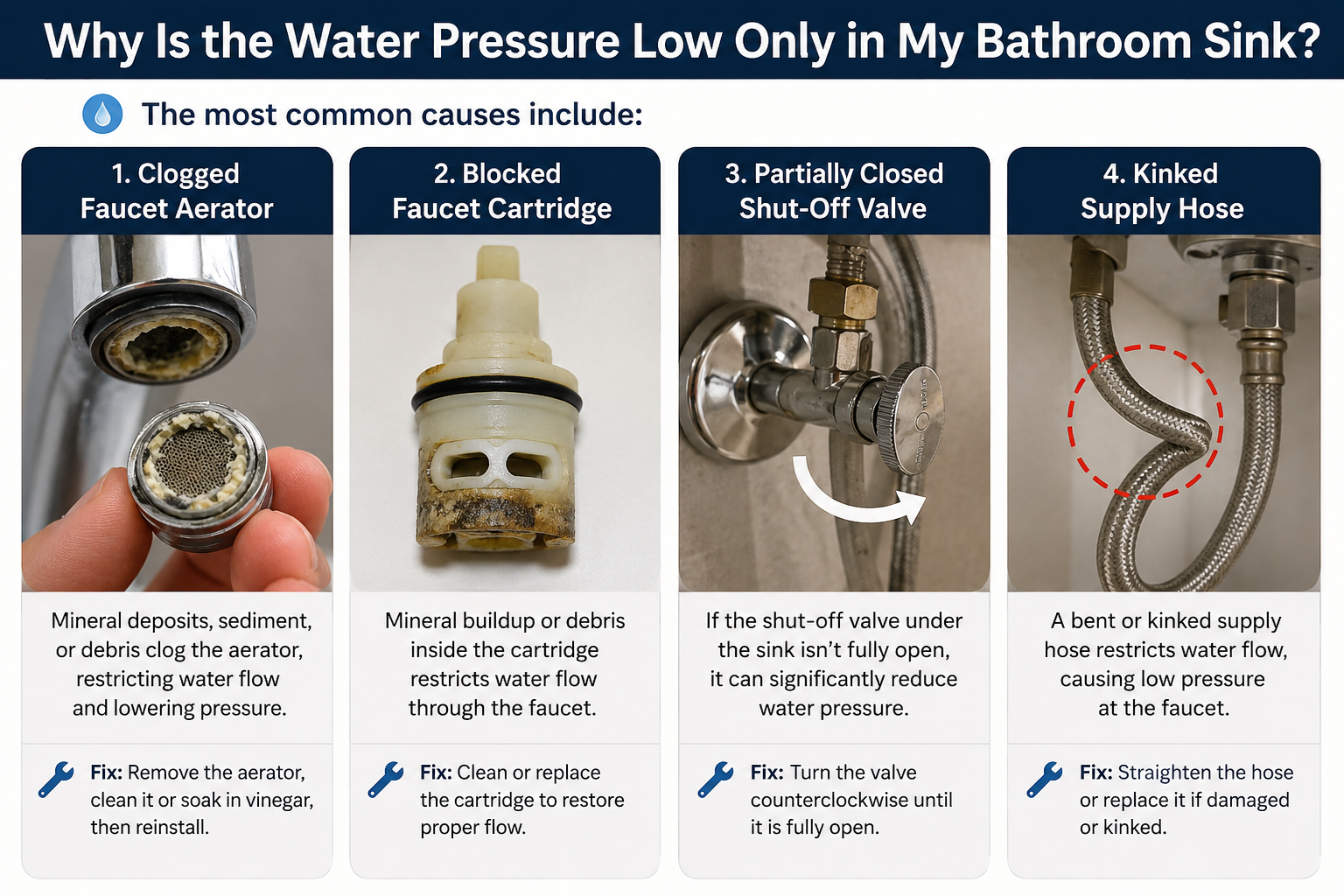
- clogged faucet aerator
- blocked faucet cartridge
- partially closed shut-off valve
- kinked supply hose
If the shower, kitchen sink, and toilet work normally, the home's main water pressure is usually not the issue.
According to the International Association of Plumbing and Mechanical Officials, fixture restrictions and mineral buildup are among the most common causes of reduced residential faucet flow.
Can a Clogged Aerator Cause Low Bathroom Sink Pressure?
Yes. A clogged aerator is the most common reason for low bathroom sink water pressure.
The aerator is the small screen attached to the faucet tip. It traps:
- sediment
- rust particles
- calcium deposits
- pipe debris
In hard water homes, mineral buildup can reduce faucet flow by 30% to 50% over time.
Signs the Bathroom Sink Aerator Is Clogged
- Water pressure slowly decreased
- Water sprays unevenly
- Faucet sputters
- Only one sink has low pressure
How to Fix a Clogged Bathroom Sink Aerator
- Unscrew the aerator carefully
- Soak it in white vinegar for 30 to 60 minutes
- Scrub away buildup with a small brush
- Reinstall or replace the aerator
Many homeowners searching for a plumbing supply store online start with aerator replacement because it is inexpensive and DIY-friendly.
Why Is the Hot Water Pressure Low in My Bathroom Sink?
Low hot water pressure in a bathroom sink usually points to:
- water heater sediment
- clogged hot-side cartridge
- partially closed hot water valve
- mineral buildup inside pipes
If cold water pressure remains normal, the problem is often isolated to the hot water side.
The US Department of Energy notes that scale accumulation inside plumbing systems can reduce water flow and fixture efficiency over time.
Signs the Problem Is on the Hot Water Side
| Symptom | Likely Cause |
|---|---|
| Weak hot water only | Sediment buildup |
| Hot water sputters | Air or mineral blockage |
| Slow hot water flow | Cartridge restriction |
| Pressure worsens over time | Scaling inside pipes |
Can a Faucet Cartridge Reduce Bathroom Sink Water Pressure?
Yes. A clogged or damaged faucet cartridge can restrict bathroom sink water pressure significantly.
The cartridge controls:
- water flow
- temperature mixing
- pressure balance
Over time, minerals and debris accumulate inside the cartridge and reduce flow.
Signs of a Bad Bathroom Sink Cartridge
- Handle feels stiff
- Water pressure is inconsistent
- Hot and cold flows are uneven
- Aerator cleaning did not fix the issue
Most faucet cartridges are brand-specific, so matching the correct replacement model matters.
Why Did My Bathroom Sink Lose Pressure Suddenly?
Sudden bathroom sink pressure loss usually happens after:
- plumbing repairs
- municipal water shutoffs
- pipe maintenance
- faucet replacement
- water heater servicing
Sediment often breaks loose inside older pipes after the water supply is interrupted.
That debris then clogs:
- faucet aerators
- cartridges
- supply lines
This is especially common in older galvanized plumbing systems.
Can Shut-Off Valves Cause Low Bathroom Sink Pressure?
Yes. Partially closed shut-off valves commonly reduce bathroom sink water pressure.
Bathroom sink shut-off valves are located beneath the vanity. Even a slightly closed valve can reduce fixture flow noticeably.
How to Check Bathroom Sink Shut-Off Valves
- Locate hot and cold valves beneath the sink
- Turn both valves counterclockwise fully
- Test sink pressure again
This is one of the fastest low-pressure fixes in residential plumbing.
Can Kinked Supply Lines Reduce Sink Water Pressure?
Yes. Damaged or kinked supply lines can reduce bathroom sink water pressure immediately.
Flexible supply hoses may:
- bend sharply
- collapse internally
- clog with debris
- corrode over time
Signs of a Bad Sink Supply Hose
- Pressure changed suddenly
- One side is weaker than the other
- Hose looks sharply bent
- Flow fluctuates during use
Replacing supply hoses is usually inexpensive and takes less than one hour.
For urgent repairs, contractors often source emergency plumbing supplies outside normal business hours.
Can Pipe Corrosion Cause Low Bathroom Sink Pressure?
Yes. Corroded galvanized pipes are a major cause of low bathroom sink water pressure in older homes.
As corrosion builds inside pipes:
- pipe diameter shrinks
- water flow slows
- pressure drops gradually
Signs of Corroded Plumbing Pipes
| Symptom | Why It Happens |
|---|---|
| Rust-colored water | Pipe corrosion |
| Multiple fixtures losing pressure | Restricted water flow |
| Frequent clogs | Internal pipe buildup |
| Pressure worsens yearly | Aging galvanized pipes |
Modern plumbing upgrades often use:
- PEX piping
- copper tubing
- brass valves
- press fittings
These materials improve flow consistency and resist internal corrosion better than galvanized steel.
Can a Pressure Regulator Cause Low Sink Pressure?
Yes. A failing pressure-reducing valve (PRV) can lower pressure throughout the home, including bathroom sinks.
A bad PRV usually affects:
- showers
- kitchen faucets
- outdoor spigots
- toilets
Signs of a Failing Pressure Regulator
- Pressure fluctuates throughout the day
- Multiple fixtures lose pressure
- Plumbing noises increase
- Sink pressure changes suddenly
If the entire home has weak pressure, the PRV may require professional replacement.
How Long Does It Take to Fix Low Bathroom Sink Pressure?
| Repair | Average Repair Time |
|---|---|
| Clean aerator | 10 minutes |
| Replace faucet cartridge | 30 to 60 minutes |
| Replace the supply hose | 20 to 40 minutes |
| Replace the shut-off valve | 1 to 2 hours |
| Replace the pressure regulator | 2 to 4 hours |
Most single-faucet pressure problems are relatively quick to diagnose and repair.
Bathroom Sink Pressure Problems by Symptom
FAQs About Low Bathroom Sink Water Pressure
Why is my bathroom sink pressure low all of a sudden?
Sudden low bathroom sink pressure is usually caused by sediment clogging the aerator or cartridge after plumbing work or a water shutoff.
Why is only the hot water pressure low in my bathroom sink?
This commonly points to:
- water heater sediment
- clogged hot-side cartridge
- partially closed hot water valve
Can a faucet cartridge lower water pressure?
Yes. Mineral buildup inside the cartridge can restrict water flow and reduce bathroom sink pressure.
Why is my bathroom sink pressure low but my shower works fine?
If the shower pressure is normal, the issue is usually isolated to the bathroom sink faucet, aerator, cartridge, or supply lines.
Should I replace the faucet if the bathroom sink pressure is low?
Not always. Most low bathroom sink pressure problems are caused by removable components like:
- aerators
- cartridges
- supply hoses
- shut-off valves
Replacing the entire faucet is often unnecessary.
Ready for an Upgrade?
Low bathroom sink water pressure is often caused by clogged aerators, worn cartridges, damaged supply lines, or aging plumbing components. While many pressure problems can be fixed quickly, recurring issues may point to larger concerns like pipe corrosion, water heater sediment, or failing valves.
Upgrading worn plumbing parts early can improve:
- Water flow consistency
- Faucet performance
- Long-term plumbing reliability
- Overall bathroom efficiency
If you need faucet parts, valves, PEX fittings, repair tools, or commercial plumbing supplies, explore 24HR Supply for professional-grade plumbing and HVAC products available when you need them.
Recent Posts
-

Gruvlok vs. Victaulic: Key Differences in Couplings, Fittings, and Performance
A contractor, estimator, engineer, or buyer may find one grooved piping brand listed in the project …Sep 15th 2026 -
Grundfos Scala 1 vs. Scala 2: A Practical Buyer’s Guide for Homeowners
Choosing between Grundfos SCALA 1 vs. SCALA 2 comes down to how your home uses water and how much co …Sep 14th 2026 -
How to Use a Tube Cutter for Clean, Accurate Cuts Without Damaging the Tubing
When you need to shorten, repair, replace, or prepare tubing, the cut has to come out straight and c …Sep 9th 2026