What Is a Grease Trap? How It Works and Why Commercial Kitchens Need One
Even when a commercial kitchen keeps fryer oil out of the sink, grease still finds its way into wastewater. Dishwashing, food prep, floor cleaning, and rinsing pans all send small amounts of fats, oils, grease, and food residue toward the drain.
So, what is a grease trap, and where does it fit into that process? It catches much of this material before wastewater moves farther downstream. We’ll explain how it works, sizing, plumbing, maintenance, and what to compare when choosing one.
What Is a Grease Trap?
A grease trap is a plumbing device that receives grease-laden wastewater and separates fats, oils, grease, and some food solids before the water continues into the drainage system.
Those fats, oils, and grease are commonly grouped under the term FOG. Restaurants and other foodservice operations deal with FOG every day because washing dishes, cookware, utensils, and food-prep equipment sends residue toward kitchen drains.
If you’re looking for the grease trap meaning in practical terms, think of it as a holding and separation point between kitchen fixtures and downstream plumbing. The purpose of a grease trap is to keep as much FOG and solid material as possible from building up farther down the line.
That matters. A 2022 academic review estimated that FOG deposits are associated with roughly 30-40% of sewer blockages . Keeping more of that material contained makes downstream plumbing easier to protect.
How Does a Grease Trap Work?
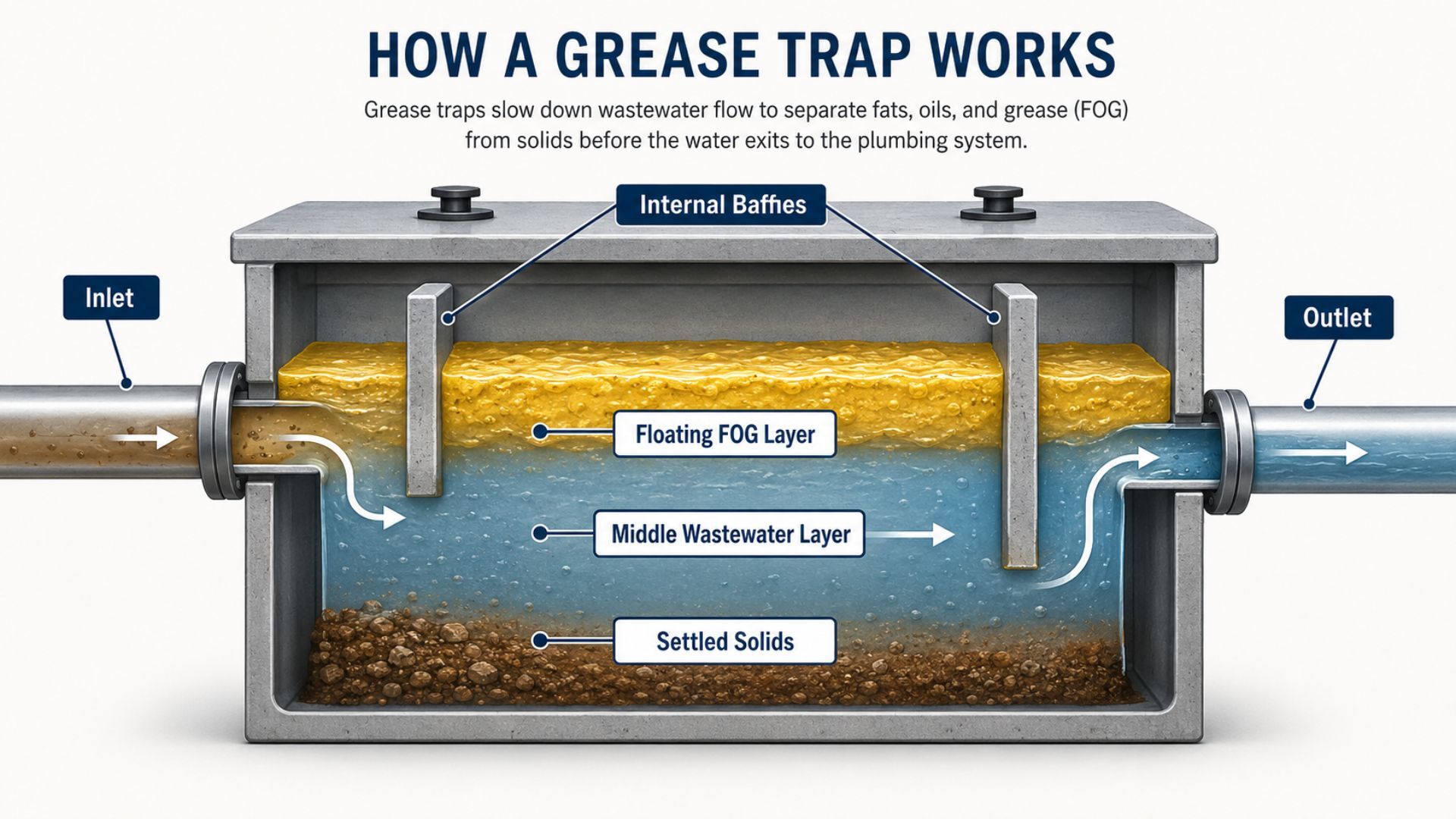
A grease trap works by slowing grease-laden wastewater long enough for lighter FOG to rise and heavier food solids to settle.
The process itself is fairly simple once you see what is happening inside the tank. Most conventional units depend mainly on gravity and retention time. Here is how the process works:
- Wastewater enters the trap: Water carrying FOG and food residue enters through the inlet.
- The flow slows down: That extra time gives materials with different densities a chance to separate.
- FOG rises and solids settle: Grease collects toward the surface while heavier food particles settle toward the bottom.
- Baffles help retain the waste: Internal baffles slow and direct the flow, which helps keep collected grease away from the outlet.
- Wastewater exits: The middle liquid layer moves through the outlet and continues into the drainage system.
Here’s a grease trap diagram that shows how wastewater moves through the unit:
In practical terms, this separation process explains what a grease trap does. Its performance can vary with sizing, wastewater temperature, flow conditions, and maintenance, so the trap still needs to be chosen and cared for properly.
How Does a Grease Trap Fit Into Commercial Kitchen Plumbing?
A grease trap fits between grease-producing kitchen fixtures and the downstream drainage system so FOG can separate before wastewater moves farther through the plumbing.
A basic grease trap plumbing path looks like this:
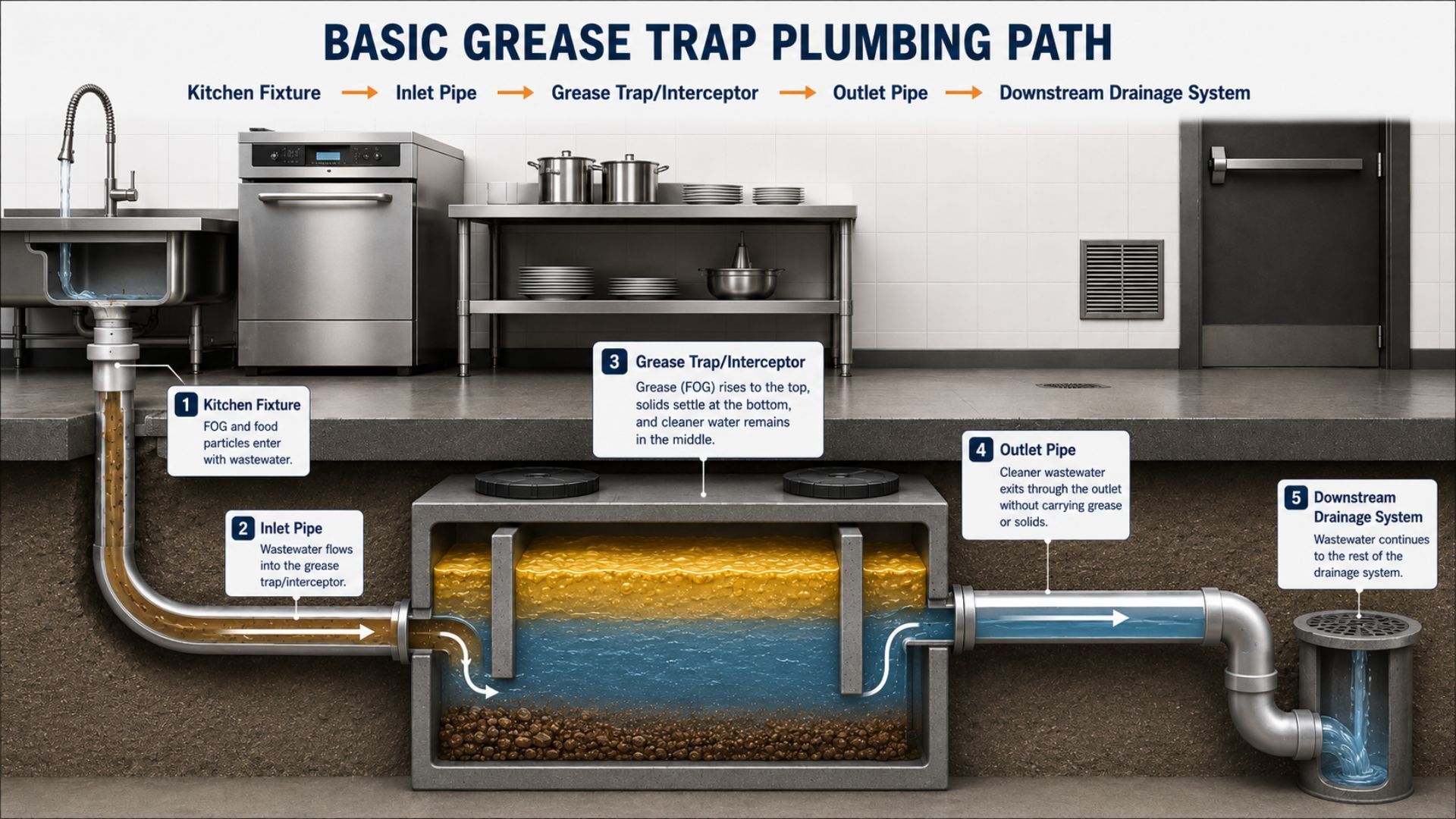
So, what is a grease trap used for in this setup? It creates a controlled separation point before grease reaches farther sections of the waste line.
This matters across the whole kitchen. About 90% of FOG discharged by foodservice establishments may originate from pot-wash sinks, floors, and pre-rinse sinks. Fryer oil is only part of the issue.
Connections, venting, and flow-control requirements vary by model. For installation work, use the manufacturer’s grease trap installation diagram and follow applicable plumbing requirements.
Grease Trap Calculator: What Size Grease Trap Do You Need?
The grease trap you need should have enough flow capacity and grease capacity for the fixtures and wastewater load connected to it.
Sizing deserves some care because picking a unit by physical dimensions alone can lead you in the wrong direction. We usually recommend treating the calculation as a starting point for product selection and then checking the manufacturer’s specifications and local plumbing requirements.
Here are the two parts that matter.
What the Calculator Should Estimate
A grease trap calculator should estimate the required flow rate in gallons per minute, or GPM, so you can narrow down which units may suit the job.
Useful inputs can include:
- Sink length, width, and depth
- Number of sink compartments
- Estimated usable water volume
- Expected drain time
- Connected fixture information where applicable
The result should give you an estimated minimum flow-rate range. From there, confirm the figure against the equipment documentation and requirements for the project.
How to Use the Result
Once you have an estimated GPM, compare the size of grease trap you are considering by flow rating, grease capacity, connection size, physical dimensions, and installation requirements.
For example, a Zurn 20 GPM grease trap shows how flow rate appears directly in a product specification. A 20 GPM unit is simply an example here. Your actual project may require a different rating or configuration.
You can use the calculator here:
Enter connected sink dimensions and drainage conditions to estimate the minimum required grease trap flow rate (GPM).
What Is the Difference Between a Grease Trap and a Grease Interceptor?
A grease trap and a grease interceptor perform the same basic FOG-separation job, although the term interceptor commonly describes larger or higher-flow commercial systems.
The terminology can shift between manufacturers and jurisdictions, which is why specifications matter more than the label alone. For grease trap vs grease interceptor comparisons, these are the practical differences to check:
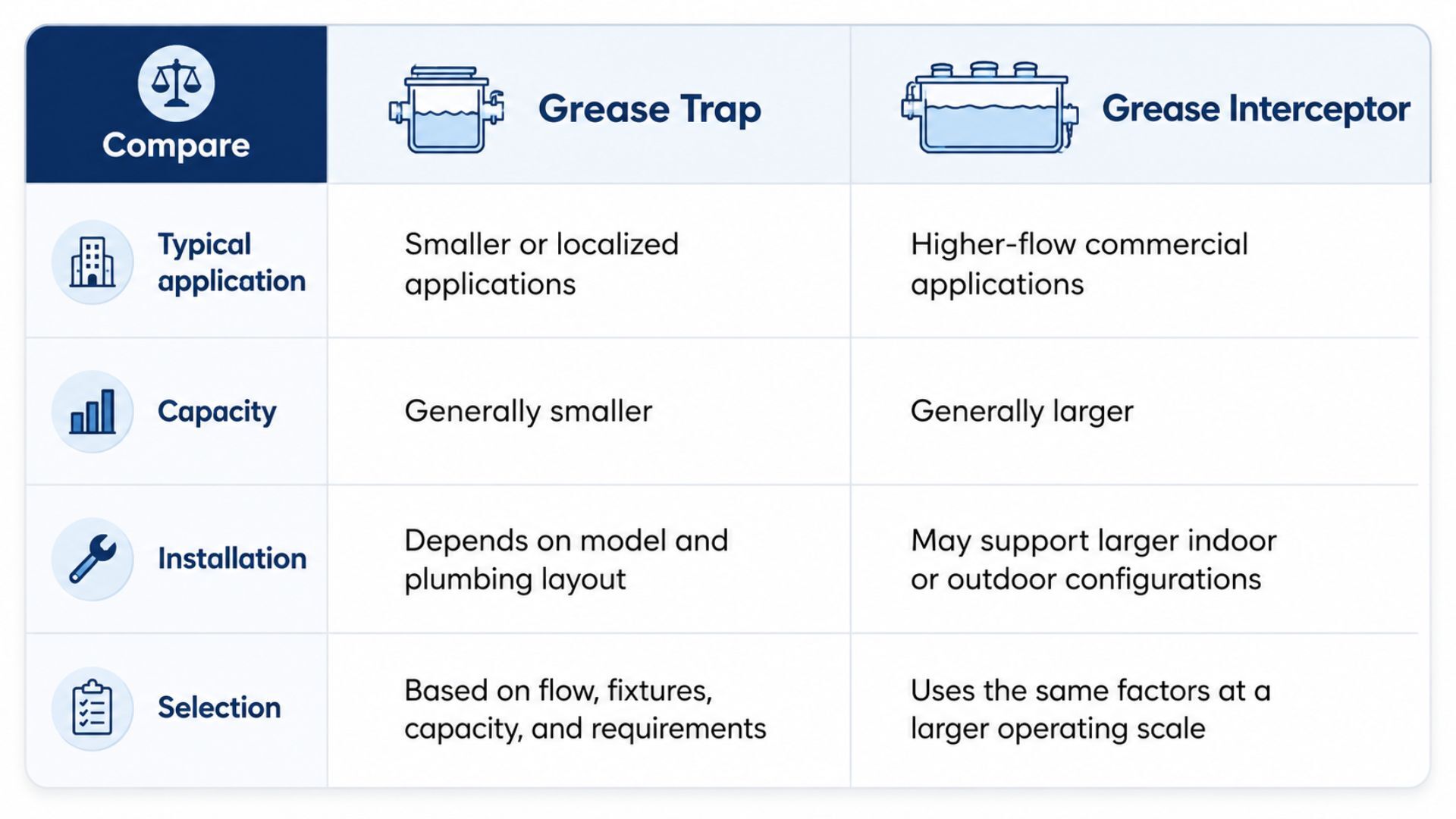
For higher-flow applications, grease interceptors for commercial kitchens may be a better fit because they generally offer greater capacity.
How Do You Maintain a Grease Trap?
You maintain a grease trap by limiting what enters it, removing accumulated FOG and solids, checking serviceable components, and following the requirements for that particular system.
Good grease trap maintenance starts upstream. The less unnecessary food waste and bulk grease that reaches the trap, the easier the system is to manage.
Here are the basics we recommend keeping in mind:
- Scrape food solids into waste containers before washing dishes.
- Keep fryer oil and large quantities of grease out of sinks.
- Check covers, gaskets, flow-control components, and accessible fittings for wear.
- Remove accumulated FOG and solids according to the unit requirements.
- Keep pumping or maintenance records where required.
- Follow the manufacturer’s instructions and local wastewater rules.
Cleaning procedures vary by grease trap type, size, and local requirements, so there is no single method that applies to every system. Many FOG-control programs use the 25% rule , which calls for cleaning when floating grease and settled solids together reach about 25% of the trap’s working depth or volume . Actual requirements can differ by jurisdiction and equipment.
That same maintenance check may uncover worn covers, gaskets, or flow-control components, which is where grease trap accessories and replacement parts can become relevant.
How Can 24hr Supply Help You Choose a Grease Trap?
24hr Supply can help you compare grease traps, interceptors, and related components across different flow rates, capacities, dimensions, connections, and installation configurations.
If you are searching for a grease trap for sale, we recommend looking beyond price and starting with the specifications your project actually needs. Compare GPM, grease capacity, inlet and outlet size, overall dimensions, installation requirements, and the manufacturer’s documentation.
At 24hr Supply, our selection includes smaller commercial units, low-profile options, larger-capacity interceptors, covers, and replacement accessories. That gives contractors and DIY buyers room to compare equipment based on the actual job.
You can start with our range of commercial grease traps and interceptors and narrow the options using your flow requirements and product specifications.
FAQs
How Often Should a Grease Trap Be Cleaned?
A grease trap should be cleaned often enough to keep accumulated FOG and solids within the limits required for the system. Many programs reference the 25% rule, although kitchen volume, equipment design, manufacturer instructions, and local wastewater requirements can call for a different schedule.
Where Is a Grease Trap Located?
A grease trap can be located near connected kitchen fixtures, elsewhere inside the building, below grade, or outside. The right placement depends on the unit, plumbing layout, accessibility requirements, available space, and local installation rules.
Who Installs Grease Traps?
Grease traps are generally installed by qualified plumbing professionals who understand commercial drainage and local wastewater requirements. Depending on the project, product selection, permits, inspections, and final installation approval may also need to satisfy local authorities.
What Does a Grease Trap Smell Like?
A grease trap can develop a strong, unpleasant odor because it holds grease and decomposing food residue. Odors escaping from a closed system can signal accumulated waste, a damaged cover or gasket, venting trouble, or another condition that should be inspected.
When Should a Grease Trap Be Replaced?
A grease trap should be replaced when cracking, corrosion, leaks, permanent damage, inadequate capacity, or another serious problem prevents reliable operation. Grease trap replacement can also make sense when the existing unit is undersized. Any grease trap removal should be planned as part of a properly handled replacement project.
What Does a Grease Trap Look Like?
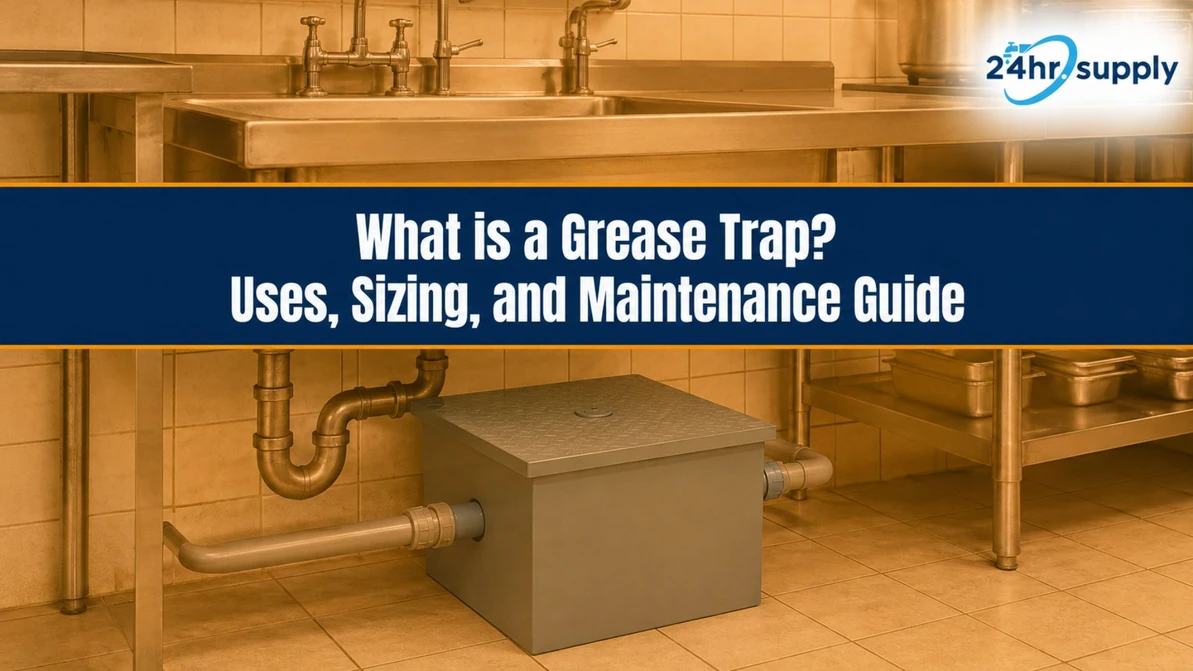
A grease trap usually looks like a sealed tank or box with an inlet, outlet, serviceable cover, and internal baffles or chambers. Smaller units can be compact, while larger commercial interceptors may be much bigger and installed in different configurations.
Recent Posts
-

How to Prime a Grundfos Pump: Step-by-Step Instructions for Homeowners
If your pump is running but the tap is still dry, switch it off before checking whether it needs pr …Oct 12th 2026 -
How Does a Grundfos Pump Work? Types, Controls, and Everyday Uses
Grundfos centrifugal pumps work through an electric motor that turns an impeller, transfers energy t …Oct 12th 2026 -
Gruvlok vs. Victaulic: Key Differences in Couplings, Fittings, and Performance
A contractor, estimator, engineer, or buyer may find one grooved piping brand listed in the project …Sep 15th 2026