Grundfos Pump Troubleshooting Guide: Problems, Fixes, and When to Replace It
Grundfos pumps do a lot of the heavy lifting behind the scenes. But when water pressure suddenly drops, the pump starts humming louder than usual, warning lights appear, or the system keeps short-cycling, tracking down the problem can get frustrating fast.
Are you in this stage right now? Well, don’t worry because we’re here to help you!
In this Grundfos pump troubleshooting guide, we’ll work through the most common symptoms and explain what they usually mean in real-world systems. We’ll also show you the safe checks contractors and experienced DIYers typically start with before deciding whether the pump can be repaired or if replacement is the smarter move.
P.S. If troubleshooting leads to a replacement, 24hr Supply carries everything from Grundfos circulator pumps to booster systems, with in-stock options and fast shipping for urgent jobs.
Before You Troubleshoot: Identify the Pump and Symptom
Before you grab tools or look for the Grundfos pump reset button, start with the basics. Grundfos pump troubleshooting gets a lot easier when you know exactly what pump you’re dealing with and what changed in the system.
We recommend checking these details first:
- Pump model or series: UPS, MAGNA, SCALA, MQ, CR, CMBE, or another Grundfos model.
- Application: Heating circulation, domestic hot water recirculation, booster system, well/tank supply, or commercial pressure system.
- Main symptom: No power, no flow, noise, leaks, short cycling, low pressure, alarm light, overheating, or breaker trips.
- Voltage and installation details: Use the pump label to confirm voltage, phase, horsepower, and connection type.
- When the issue started: Suddenly, after maintenance, after draining/refilling, after long idle time, or right after installation.
Pro tip: Turn off power before touching the pump, don’t open electrical components unless qualified, and call a professional for electrical faults, leaks near wiring, or alarms that keep coming back.
Step-by-Step Grundfos Pump Troubleshooting Guide
A good troubleshooting process starts with power, water, air, blockage, and then internal parts. Some modern pump motors can reach surface temperatures up to 90°C / 194°F, so give the unit time to cool and always shut off power before handling it.
Here are the key checks to work through before deciding whether the pump needs service, parts, or replacement.
1. Check the Power Supply and Controls
If a Grundfos pump is completely dead, start at the power source before assuming the pump failed. Check the breaker, fuse, wall switch, plug, disconnect, and control panel.
On a jobsite, this is the “is the truck actually out of gas?” step. It sounds obvious, but a tripped breaker or loose plug can look like a bad motor.
For electronic pumps, check the display, warning lights, or alarm log. A red light, flashing code, or stored alarm can point you toward blocked operation, unstable voltage, sensor issues, or dry-running protection. If the pump hums but does not run, the rotor or shaft may be stuck, or the capacitor or motor may have failed.
Important: Voltage testing, motor winding checks, capacitor testing, and wiring repairs should be handled by a licensed technician. If you smell burning, see melted wiring, or the breaker trips again after reset, stop there.
2. Look for Air, Priming, or Water Supply Issues
A pump can sound like it is running and still move little or no water. That usually means it is airbound, not primed, or starved for water.
In plain terms, the pump needs water inside the chamber to push water through the system. If there is too much air, the impeller can spin without moving the flow properly.
For heating systems, air usually shows up after draining, refilling, or replacing a component. That is why Grundfos circulation pump troubleshooting often starts with bleeding the system and confirming system pressure. If a radiator loop was recently opened, the pump may not be the problem at all.
For booster pumps, check the source tank, supply line, inlet valve, and any low-water conditions. Running a pump dry can damage internal parts, so do not keep restarting it if there is no water reaching the inlet.
3. Inspect Strainers, Check Valves, and Piping
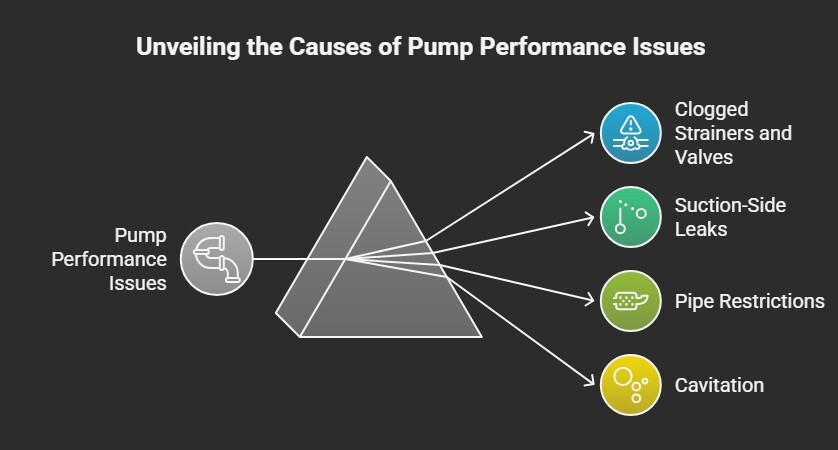
Restricted flow can make a healthy pump look weak. Clogged strainers, check valves, or foot valves can reduce flow, cause pressure drops, or make the pump work harder than it should.
Keep in mind: Closed or partially closed valves can create the same issue, especially after maintenance, when someone forgets to reopen a valve fully.
Suction-side leaks are another common troublemaker. These leaks may not always drip water, but they can pull air into the system and cause noisy operation, low pressure, or inconsistent flow.
Also look for pipe restrictions, undersized suction lines, or fittings that create high friction. If the pump sounds like it is moving gravel, cavitation may be happening, which means the pump is not getting enough usable water at the inlet.
4. Check for a Stuck Rotor or Seized Shaft
A stuck rotor is common on circulator pumps that have been idle for a long time, especially after a heating system sits unused through the warmer months. The symptoms are usually easy to spot. For example, the pump hums, the motor gets warm, water does not circulate, or a warning light appears.
The basic fix may involve freeing the rotor, but the exact method depends on the pump model. On some Grundfos wet-running pumps, the manufacturer says to turn off the power, remove the center screw on the nameplate, and use a screwdriver to move the shaft in its direction of rotation until the blockage clears.
On UPS3-style circulators, Grundfos says to turn off the power, close the valves, push the deblocking screw inward with a No. 2 Phillips screwdriver, and check whether it can turn counterclockwise.
Newer self-regulating pumps may not have the same access screw, so you should check the model’s manual before removing covers, plugs, or screws.
If the shaft will not rotate freely, there may be scale, debris, damaged bearings, or worn internal components. At that point, the repair may require disassembly, service parts, or replacement.
5. Diagnose Short Cycling or Pressure Problems
Short cycling means the pump starts and stops too frequently. In booster and pressure systems, this can come from a pressure tank air-charge issue, faulty pressure switch, bad sensor, system leak, undersized tank, oversized pump, or incorrect settings.
For example, your home has decent pressure for a few seconds, then the pump kicks on and off every time someone opens a faucet. That is annoying, and it can wear out components faster.
This is where Grundfos pressure pump troubleshooting should include checking for leaking fixtures, damaged piping, tank pressure, and control settings.
When a Grundfos pump is not turning off, look for hidden leaks, stuck check valves, or a pressure sensor that is not reading correctly.
6. Pay Attention to Noise
Noise tells a story. For example:
- A rattling or “gravel” sound can point to cavitation.
- Gurgling typically means air is trapped in the system.
- Grinding or scraping may suggest worn internal components, debris, or impeller contact.
- Squealing on some pump designs can point to coupling, stack height, or alignment issues.
We recommend not ignoring a pump that suddenly gets louder. A small noise can become a failed seal, damaged impeller, or overheated motor if the root cause is not fixed.
This is especially important when doing a Grundfos water pump troubleshooting, where low inlet supply, clogged filters, and suction leaks can all show up as noise before the pump fully fails.
Pro tip: Check out our other guide on noise reduction strategies for your booster pumps.
7. Check for Leaks and Visible Damage
Inspect around flanges, gaskets, seals, housing, unions, and pipe connections. Keep in mind that:
- A leak at the flange may only need a gasket or better alignment.
- A leak near the shaft seal can mean the seal is worn.
- A leak from the housing, sleeve, or body is more serious and may point to cracked or damaged parts.
Also, check for pipe strain. If the piping is pulling against the pump, it can stress the seals and flanges. That can cause repeat leaks even after new gaskets are installed.
Many people want to learn how to repair a Grundfos pump, but the answer depends on the failure. Air, clogged valves, stuck rotors, and some seal issues may be repairable. Repeated electrical faults, cracked housings, badly worn internals, or incorrect sizing often make replacement the smarter call.
When Troubleshooting Is Not Enough: Repair or Replace?
Not every pump issue means the whole unit is done. But when energy and maintenance can make up 50% to 95% of pump ownership costs, repeated repairs can turn into an expensive loop fast.
Here are the Grundfos pump problems that usually point toward repair versus replacement:
| Repair may make sense when… | Replacement may be smarter when… |
|---|---|
| Air is trapped in the system, and the loop needs bleeding | The motor winding has failed |
| A valve, strainer, or foot valve is clogged | Breakers trip or electrical faults keep returning |
| The rotor is stuck after sitting idle | The housing is cracked or leaking from the body |
| Settings, pressure controls, or sensors need adjustment | Corrosion is severe |
| A gasket, seal, capacitor, or valve can be replaced | Internal pump parts are badly worn |
| A small piping issue is causing noise, leaks, or poor flow | The pump is incorrectly sized or too old to trust |
When replacement is the better call, 24hr Supply stocks Grundfos circulator pumps, booster pumps, stainless steel circulators, commercial pump options, and related components.
Finding the Right Grundfos Replacement at 24hr Supply
When troubleshooting points to replacement, the goal is to match the pump to the system. At 24hr Supply, we carry a broad range of Grundfos pumps for heating, plumbing, circulation, and pressure boosting, so contractors and DIYers can compare options without digging through scattered spec sheets.
Our product pages help you check the details that matter on the job. That includes voltage, horsepower, flow rate, max head, pipe or flange compatibility, and the right application. Many listings also include manuals and spec sheets, which makes it easier to verify fit before you order.
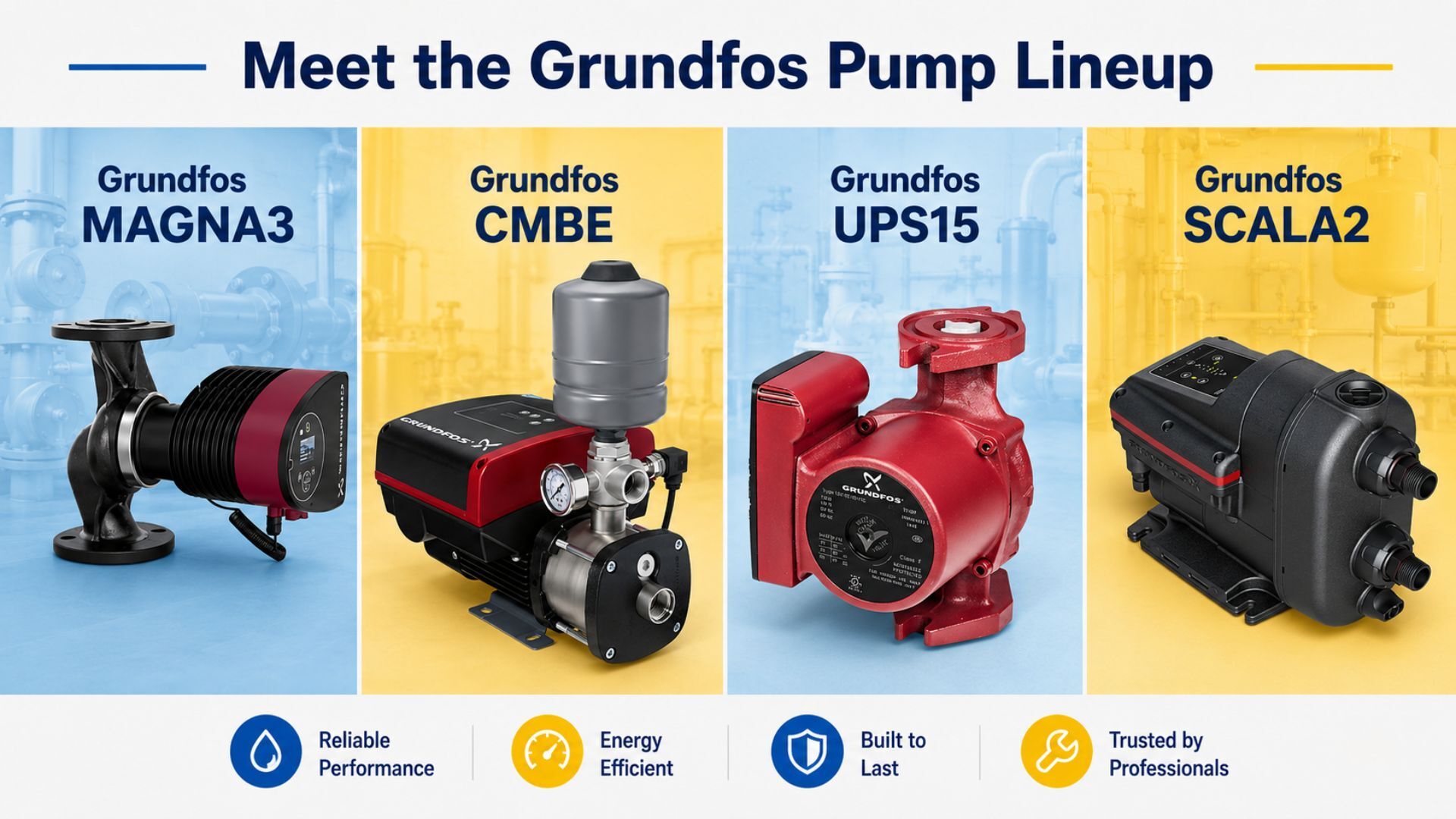
Common Grundfos options we carry include:
- Grundfos SCALA2 pressure boosting pumps for residential water pressure.
- Grundfos UPS circulator pumps for heating and hot water circulation.
- Grundfos CMBE booster systems for pressure boosting applications.
- Grundfos MAGNA3 circulators for advanced commercial circulation systems.
We also focus on in-stock products, fast fulfillment, shipping options, and same-day delivery where available in the NYC area.
FAQs
What are common problems with Grundfos pumps?
Common Grundfos pump problems include no power, no flow, low pressure, short cycling, leaks, noise, overheating, alarm lights, and tripped breakers. We think you should start with the simple checks first. This includes power, air in the system, closed valves, clogged strainers, and water supply.
Where is the reset button on the Grundfos pump?
The reset button on a Grundfos pump is usually on the control panel, front display, or motor casing, but not every model has a separate reset button. Some models reset through the on/off button, display menu, or power cycle, so check the pump manual before resetting repeated alarms.
How to test Grundfos pumps?
Test a Grundfos pump by checking power, listening for operation, confirming water flow, reading pressure, bleeding air, inspecting valves, and checking for leaks. Leave voltage tests, capacitor checks, motor winding checks, and wiring diagnosis to a qualified technician.
What do the lights on Grundfos pumps mean?
Grundfos pump lights usually show operating status: green often means normal, yellow means warning, and red means alarm or fault. The exact meaning depends on the model, so use the light code as a clue and check the manual.
Can a Grundfos pump be repaired?
Yes, a Grundfos pump can usually be repaired if the issue is air, blockage, a stuck rotor, bad settings, a gasket, seal, valve, or capacitor. Replacement is smarter for cracked housings, failed motors, severe corrosion, or repeated electrical faults.
How long do Grundfos pumps typically last?
Grundfos pumps can last many years when sized correctly, installed properly, and protected from dry running, debris, poor water quality, and electrical issues. Lifespan depends on the model, workload, maintenance, and whether problems are fixed early.
Recent Posts
-

Grundfos SCALA2 Reviews: What You Should Know Before Buying
The Grundfos SCALA2 is a variable-speed pressure booster pump designed for residential water systems …Jun 20th 2026 -
Grundfos SCALA2 Problems: Common Issues, Fixes, and When to Replace It
The Grundfos SCALA2 is a compact pressure booster pump built to improve water pressure in homes and …Jun 2nd 2026 -
Grundfos Pump Troubleshooting Guide: Problems, Fixes, and When to Replace It
Grundfos pumps do a lot of the heavy lifting behind the scenes. But when water pressure suddenly dro …Jun 2nd 2026