Is Hot Water on the Left or Right? Faucet Checks and Fixes That Help at Home Now
Standing at a faucet with a backward handle can make a simple job feel confusing fast. If you searched “Is hot water on the left or right?”, the answer is simple in most homes.
Hot is usually left, and cold is usually right.
The confusion starts when you deal with single-handle faucets, shower valves, laundry hookups, crossed supply lines, or a cartridge that was set up the wrong way.
In this guide, we’ll break down what is normal, what to check, and when the fix may need new parts.
Is Hot Water on the Left or Right?
Hot water is usually on the left, and cold water is usually on the right when you are facing the faucet or fixture outlet.
That is the clearest answer to what side is hot water usually on in most residential and commercial plumbing layouts. It applies to most two-handle faucets, many sink faucets, and standard fixture setups.
The 2015 International Residential Code P2722.2 says fixture fittings supplied with hot and cold water should be installed so the left-hand side of the temperature control represents hot water when facing the outlet.
You can use that as the practical starting point when checking a faucet, sink, or shower. Single-handle fixtures can make the answer feel less obvious because the handle may move forward, backward, left, or right based on the fixture design.
Why Is Hot Water Usually on the Left?
Hot water is usually on the left because that layout gives users, contractors, and maintenance teams a consistent way to understand a fixture.
The goal is predictability. A person should be able to walk up to a kitchen sink, bathroom sink, laundry hookup, or shower and have a reasonable idea of which side controls hot water.
That consistency also helps with safety. When someone expects cold water and gets hot water, the surprise matters most at a tub or shower where water hits skin directly.
Plumbers, installers, inspectors, and property maintenance teams also rely on the same pattern when they install, check, or troubleshoot fixtures. Older plumbing habits may have influenced the left-hand layout, yet the modern reason is simple. This means consistent fixtures are easier and safer for everyone to use.
Pro tip: Check out our guide on the causes and fixes of low hot water pressure to learn how to fix this problem.
What If Hot and Cold Water Are Reversed?
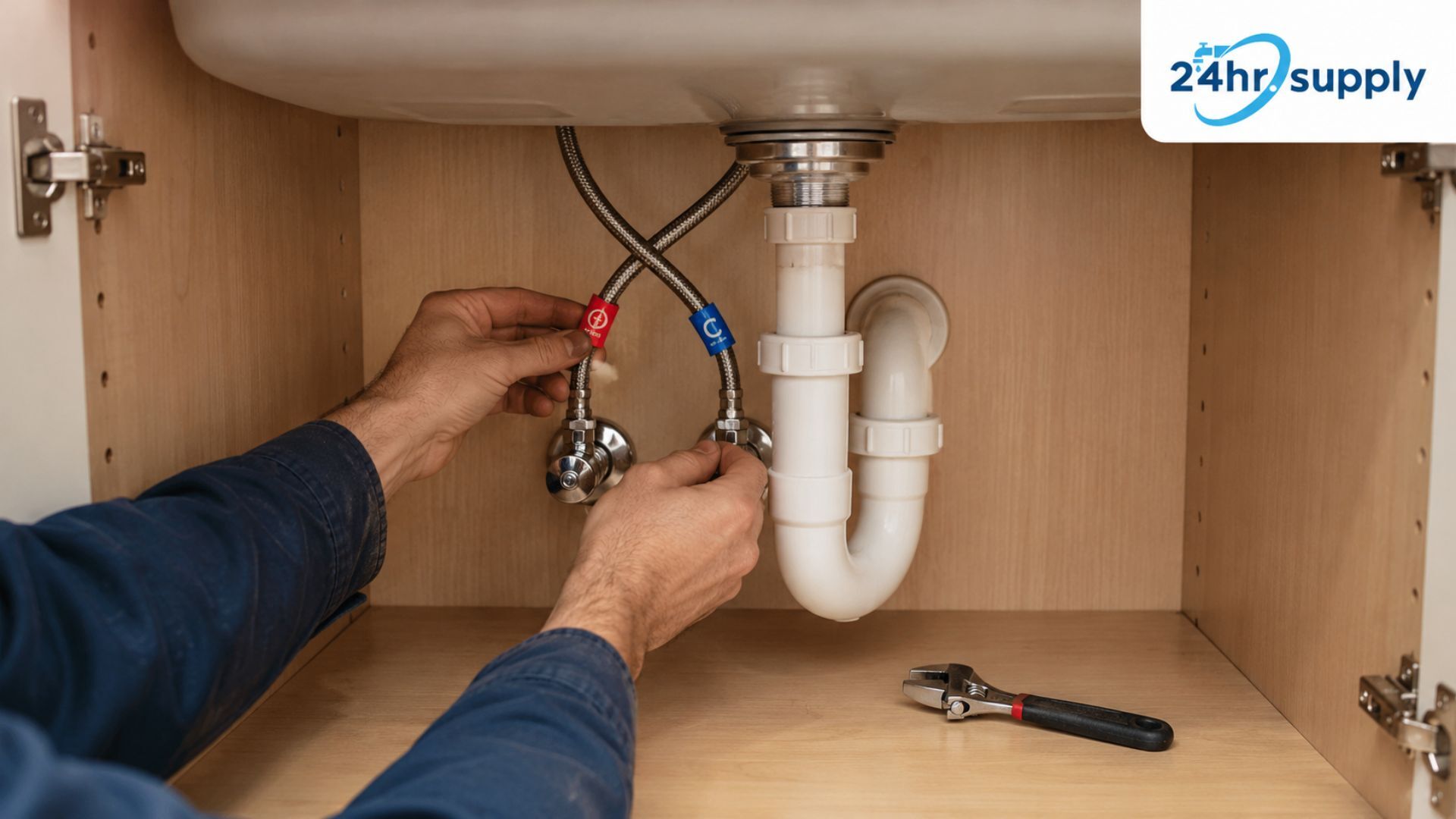
Reversed hot and cold water usually means something was connected, installed, or adjusted incorrectly. In many sink situations, the problem is fixable because the visible supply lines under the fixture may be crossed.
We recommend starting with the simplest visible parts before assuming there is a larger plumbing issue. A reversed fixture can come from a quick repair, a remodel, or a replacement faucet that was connected in a hurry.
These are the common causes to check:
- Crossed faucet supply lines under the sink.
- Hot and cold rough-in lines placed on opposite sides during a remodel.
- A single-handle faucet cartridge installed incorrectly.
- A shower cartridge or valve set for reverse installation.
- Laundry hoses connected to the wrong valves.
- Older plumbing repairs that were completed inconsistently.
The easiest check is usually at the fixture first. Look at the handle markings, then look at the supply lines, then move toward the valve or cartridge if the visible connections seem correct.
When a Reversed Hot Side Is More Than an Annoyance
A reversed hot side becomes more than an annoyance when it creates surprise for the person using the fixture. Children, older adults, guests, tenants, and anyone using a shower or tub may react quickly if the water gets hotter than expected.
At a bathroom sink, the mistake may feel minor. In a shower, the same issue can matter more because someone may turn the control toward what they think is cold and receive hot water instead.
Did you know? Tap-water burns cause an estimated 1,500 hospital admissions and 100 deaths per year in the U.S. This is according to a Johns Hopkins summary of a 2013 Journal of Burn Care & Research study.
Our team believes that you should take this especially seriously in rentals, multifamily buildings, commercial bathrooms, and homes with kids or older adults. Property managers, landlords, and contractors should treat hot/cold orientation as a usability and safety detail because people rely on fixtures to behave in a consistent way.
Can You Fix Reversed Hot and Cold Water Yourself?
You may be able to fix reversed hot and cold water yourself if the issue is limited to visible, crossed sink supply lines, and you are comfortable shutting off the water. We would be more cautious with showers, cartridges, hidden piping, leaks, and remodel-related problems because those can involve parts behind the wall or code-related work.
So, you can start by identifying where the reversal happens. A bathroom sink issue is usually easier to inspect than a tub/shower valve. These are the practical categories we recommend using:
- DIY-friendly: Checking handle labels, confirming hot/cold sides, and inspecting visible supply lines.
- Maybe DIY-friendly: Replacing a faucet supply line if the size and connection type are clear.
- Better for a plumber: Shower valves, wall piping, cartridge problems, leaks, and code-related remodel work.
- Stop immediately: Water damage, corroded valves, stuck shutoffs, or uncertainty about what controls the hot line.
For a sink, shut off the valves before touching any supply hose. Then, verify which line feeds hot water and which line feeds cold water. For a shower or tub, we would avoid guessing because the valve, cartridge, and trim may need to match the manufacturer’s setup.
What Parts Might Be Involved If the Hot Side Is Wrong?
The parts involved depend on where the hot/cold reversal shows up. A sink issue may need a small connection fix, while a shower issue may point to a valve, trim, stem, or cartridge.
When people describe a hot water on sink problem, we always recommend starting with identifying the fixture and the visible connections before choosing any part. The same symptom can come from different causes.
These are the parts that may be involved:
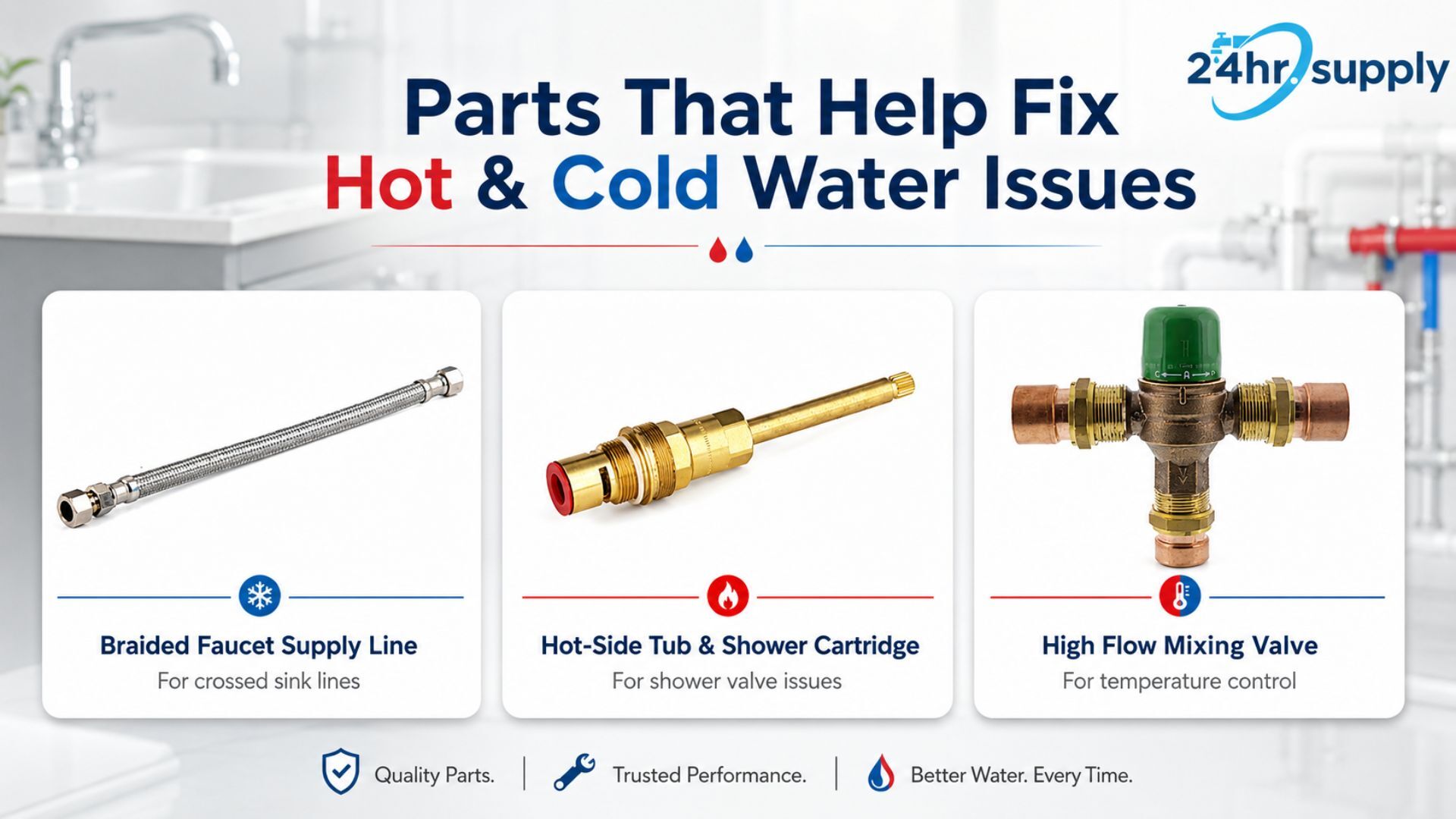
- Faucet supply lines or flexible hoses for sink connection problems.
- Stops and risers for under-sink shutoff and supply setups.
- Faucet parts or cartridges for handle-direction issues.
- Tub and shower parts for shower valve or trim-related problems.
- Valves and fittings for remodels or larger plumbing corrections.
- Water heater or mixing valve components if the issue is temperature control instead of left/right orientation.
Identify the fixture first, then confirm the connection type, size, and part style. That order helps you avoid buying parts that solve the wrong problem.
Pro tip: If the issue points to the water heater instead of the faucet, check out our guide on hot water heater replacement cost before planning the repair.
How 24hr Supply Can Help You Find the Right Plumbing Parts
If you find crossed lines, worn faucet parts, shower valve issues, or a fixture replacement need, 24hr Supply can help you source the supplies for the job. We carry professional plumbing and heating supplies for residential and commercial work.
This includes faucets, sink parts, flexible hoses, stops and risers, valves, tub and shower parts, water heaters, PEX, fittings, and plumbing repair parts.
24hr Supply supports the buying process with product spec sheets, knowledgeable customer support, fast fulfillment, New York shipping, and a 90-day return policy. That matters when you are matching a supply line, valve, cartridge, or repair part.
The right fix starts with the right diagnosis, then the right part for that exact fixture.
Check out our plumbing parts to find the best fit for your situation!
Recent Posts
-

Is Hot Water on the Left or Right? Faucet Checks and Fixes That Help at Home Now
Standing at a faucet with a backward handle can make a simple job feel confusing fast. If you search …Jun 24th 2026 -
Grundfos SCALA2 Reviews: What You Should Know Before Buying
The Grundfos SCALA2 is a variable-speed pressure booster pump designed for residential water systems …Jun 20th 2026 -
Grundfos SCALA2 Problems: Common Issues, Fixes, and When to Replace It
The Grundfos SCALA2 is a compact pressure booster pump built to improve water pressure in homes and …Jun 2nd 2026