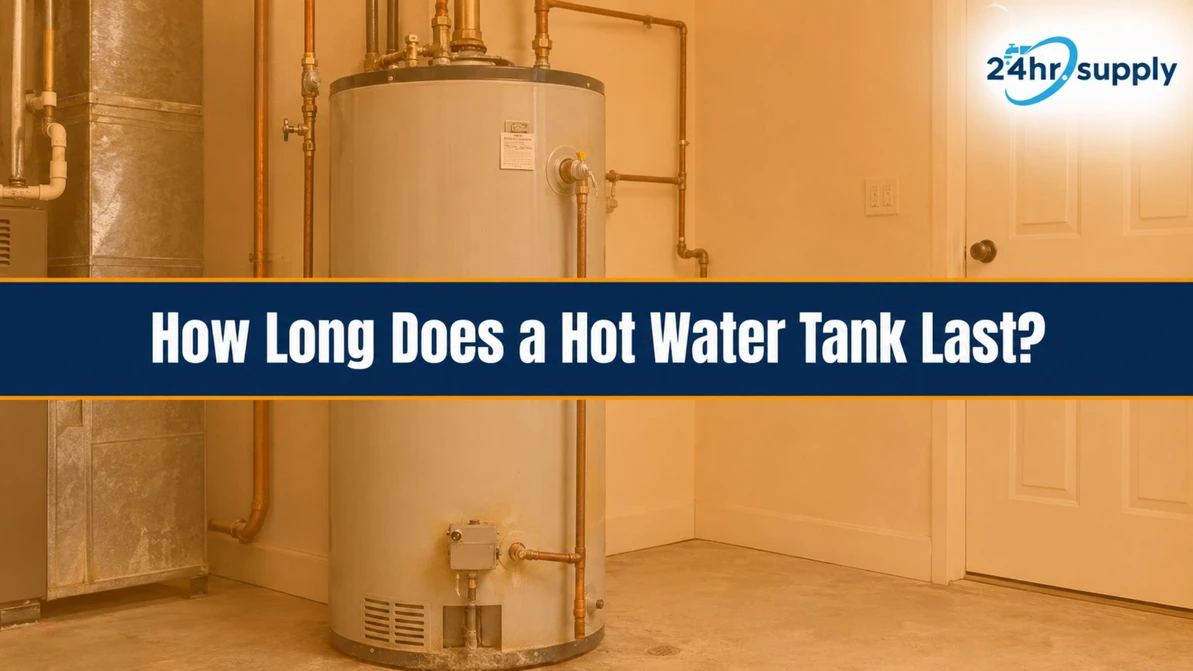
How Long Does a Hot Water Tank Last? Lifespan and Replacement Signs
A conventional hot water tank usually lasts 8-12 years. Some units fail earlier, while a sound tank with good care may keep working beyond that window. Age matters, but water quality, maintenance, tank construction, and daily use shape the real outcome.
That’s why we’ll break down these factors so you can estimate your tank’s remaining life and recognize when a repair or planned replacement makes sense.
Average Lifespan by Water Heater Type
Fuel type changes what wears out first. System design also affects how long the equipment can reasonably serve a property. Here are the planning ranges for hot water tanks vs tankless systems:
| System type | Typical lifespan | Main factor affecting longevity | When to begin planning |
|---|---|---|---|
| Conventional storage tank | 8-12 years | Corrosion and sediment | Around years 8-10 |
| Gas storage tank | Around 8-12 years | Burner wear, sediment, and corrosion | Around year 8 |
| Electric storage tank | Often 10-15 years | Heating elements, sediment, and tank corrosion | Around year 10 |
| Heat-pump water heater | Around 12-15 years | Tank condition, filters, and mechanical components | Around years 10-12 |
| Tankless water heater | 15-20+ years | Scale, water quality, and servicing | Around year 15 |
How Does a Hot Water Tank Work?
A hot water tank sends cold water through a dip tube near the bottom, where a gas burner or electric heating elements warm it. The tank holds that heated water until someone opens a hot-water fixture. Hot water then leaves through an outlet near the top, and fresh cold water enters to replace it.
This cycle happens many times during the tank’s service life. Repeated heating stresses components, while dissolved minerals settle inside the tank. Water also creates a constant corrosion risk, even with a protective lining and anode rod.
What Affects Hot Water Tank Lifespan?
Two identical tanks can reach very different ages. The conditions around the equipment typically explain the gap. Here are the main factors we examine:
| Factor | How it affects the tank | Practical response |
|---|---|---|
| Hard or corrosive water | Causes scale or speeds up corrosion | Test the water and follow suitable treatment guidance |
| Sediment | Reduces usable capacity and may create noise | Flush the tank according to its manual |
| Tank construction | Lining, steel thickness, and anode design affect corrosion resistance | Review materials and warranty before buying |
| Installation | Incorrect pressure, venting, or connections can shorten service life | Use a qualified installer |
| Household demand | Heavy daily use creates more heating cycles | Choose a properly sized unit |
| Maintenance history | Neglected sediment, valves, and anode rods allow damage to progress | Follow the manufacturer’s maintenance schedule |
Water chemistry deserves special attention because hardness is only part of the picture. An overly softened or naturally corrosive supply can also attack some steel tanks. We never assume that every water softener reduces the hot water tank life span. The result depends on the chemistry, treatment setup, anode material, and tank design.
The Hot Water Tank Life Cycle
As a tank gets older, we recommend closer monitoring and earlier replacement planning. A clear service record can also help you judge its condition. These are the usual stages:
- Early years: Expect stable performance with routine checks.
- Middle years: Watch sediment levels and anode wear more closely.
- Approaching the expected range: Check the age, warranty, corrosion, and repair history.
- Beyond the average: Keep using a sound tank, monitor it closely, and budget for replacement.
The U.S. Department of Energy’s 2024 analysis estimates that storage water heaters average around 15 years. Its model uses national surveys, shipment figures, and equipment survival data. That figure can exceed the common 8-12-year planning range because an average includes early failures and unusually long-lasting tanks.
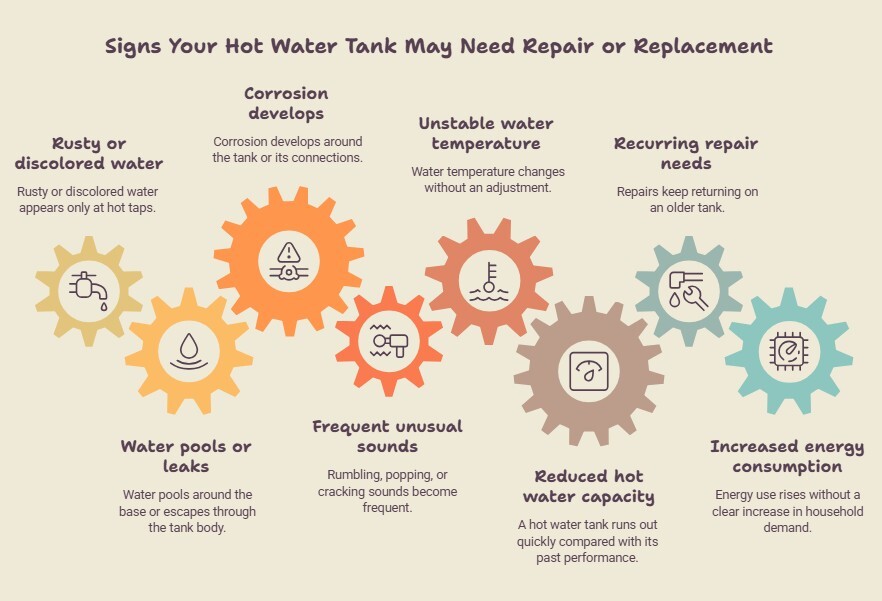
Signs Your Hot Water Tank May Need Repair or Replacement
Age gives us context, but symptoms show what the tank is doing right now. A small change can be an early warning. Here are the signs worth checking:
- Rusty or discolored water appears only at hot taps.
- Water pools around the base or escapes through the tank body.
- Corrosion develops around the tank or its connections.
- Rumbling, popping, or cracking sounds become frequent.
- Water temperature changes without an adjustment.
- A hot water tank runs out quickly compared with its past performance.
- Repairs keep returning on an older tank.
- Energy use rises without a clear increase in household demand.
These symptoms do not always call for a full replacement. Our guide to common water heater problems can help you understand what may be causing the trouble. A contractor may be able to replace a heating element, thermostat, valve, fitting, or connection.
However, a leaking or heavily corroded tank body generally means replacement is the practical path. First, identify where nearby water came from. A drain valve, pipe connection, relief valve, humidifier, or nearby appliance could be the real source.
How to Extend Hot Water Tank Life
Routine maintenance can catch small problems before they cause lasting damage. However, the right service schedule depends on the model, water quality, and current condition. Here are the steps we recommend:
- Check the manual for the correct service schedule.
- Flush the tank at the recommended interval to control sediment.
- Have the anode rod inspected and replaced once depleted.
- Look for moisture, corrosion, and loose connections.
- Have the temperature and pressure relief valve checked.
- Address unusual sounds, odors, or performance changes early.
- Test the water if scale or corrosion keeps developing.
- Arrange professional service for gas, electrical, pressure, or venting concerns.
Maintenance can limit preventable wear, though it cannot restore a corroded tank body. A neglected older tank should also be inspected before it is flushed. Heavy sediment and weakened components may require a more cautious approach.
How Long Does a Hot Water Tank Take to Fill?
Most hot water tanks take around 10-20 minutes to fill, although water pressure, pipe size, and tank capacity affect the timing. Filling and heating are separate processes. Reheating can take 20-60 minutes or longer based on fuel type, heating output, incoming water temperature, and current demand.
Very slow recovery may point to sediment, a failed electric heating element, thermostat trouble, or an undersized system. We recommend checking these possibilities before assuming the tank needs replacement.
How to Choose a Replacement Hot Water Heater
Start with the condition of your current tank. If the tank body is leaking or heavily corroded, replacing the unit makes more sense than investing in another component repair. A younger tank with an isolated valve, thermostat, or heating-element issue may still be repairable after a professional diagnosis.
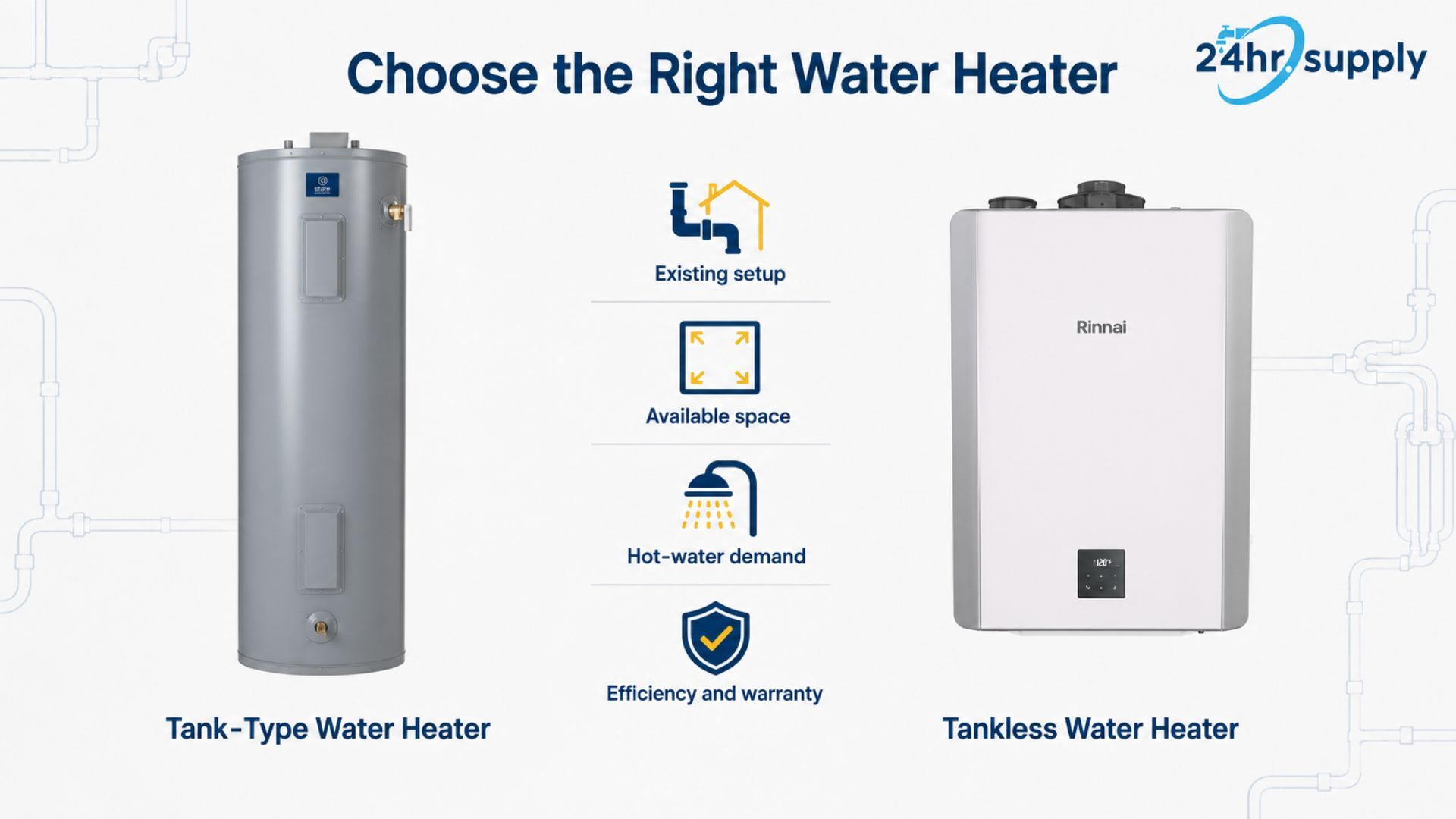
When replacement is the better choice, match the new unit to the property’s existing fuel source, venting setup, available space, and peak hot-water demand. A storage-tank model suits households that want a familiar system and predictable upfront costs.
Meanwhile, a tankless model may suit limited space and on-demand use. Then compare gallon capacity or flow rate, recovery performance, efficiency rating, warranty, and corrosion-protection features.
24Hr Supply carries residential and commercial storage-tank, tankless, and indirect water heaters, plus installation accessories and venting parts. Review the available options, confirm the specifications with your installer, and select the setup that fits the property.
Frequently Asked Questions
How Do You Know When a Hot Water Heater Needs to Be Replaced?
A hot water heater should be replaced if the tank leaks, rusty water reaches the hot taps, corrosion is spreading, or repairs keep piling up. The average life of hot water tank systems helps, though condition matters more.
Can a Tank Water Heater Last 20 Years?
Rheem states that traditional tank water heaters typically last 8-12 years, while tankless units can last 15-20 years or longer with proper care. That makes the hot water tank average life useful for early budgeting.
Should I Replace My 30-Year-Old Water Heater?
Yes. A 30-year-old water heater is well beyond the usual service range, so we recommend having it evaluated and planning its replacement. You can also review the cost to replace a hot water heater before setting your budget. Corrosion, outdated parts, reduced efficiency, and leak risk make waiting harder to justify.
Can You Still Use Water If the Water Heater Is Broken?
Usually, yes. Cold water should still work if the main supply is running. However, stop using the heater and call a qualified professional if you notice a tank leak, gas odor, electrical problem, or pressure issue.
What Is the First Thing to Check When There Is No Hot Water?
Start by checking if the problem affects one fixture or the entire property. Next, look for an error code, a tripped breaker, an interrupted fuel supply, or a visible leak. Leave internal repairs to a qualified professional.
How Long Does a Water Heater Last with Hard Water?
With untreated hard water, a tank-style water heater typically lasts about 6-10 years, compared with the usual 8-12 years. Mineral scale builds up inside the tank and around heating components, which reduces efficiency and speeds up wear.
Recent Posts
-

How to Prime a Grundfos Pump: Step-by-Step Instructions for Homeowners
If your pump is running but the tap is still dry, switch it off before checking whether it needs pr …Oct 12th 2026 -
How Does a Grundfos Pump Work? Types, Controls, and Everyday Uses
Grundfos centrifugal pumps work through an electric motor that turns an impeller, transfers energy t …Oct 12th 2026 -
Gruvlok vs. Victaulic: Key Differences in Couplings, Fittings, and Performance
A contractor, estimator, engineer, or buyer may find one grooved piping brand listed in the project …Sep 15th 2026